Ecosystems: Interactions and Balance
Key Question — How do living beings interact with each other and their environment to form a balanced ecosystem?
- Understand what an ecosystem is.
- Identify the relationships between living beings and their environment.
- Discover the concepts of food chains and food webs.
- Understand the importance of (dynamic) balance in an ecosystem.
Part 1: What is an Ecosystem?
An ecosystem is a system made up of a living environment (biotope) and the living beings (biocenosis) that live and interact there.
An ecosystem includes living beings and their environment, which constantly interact.
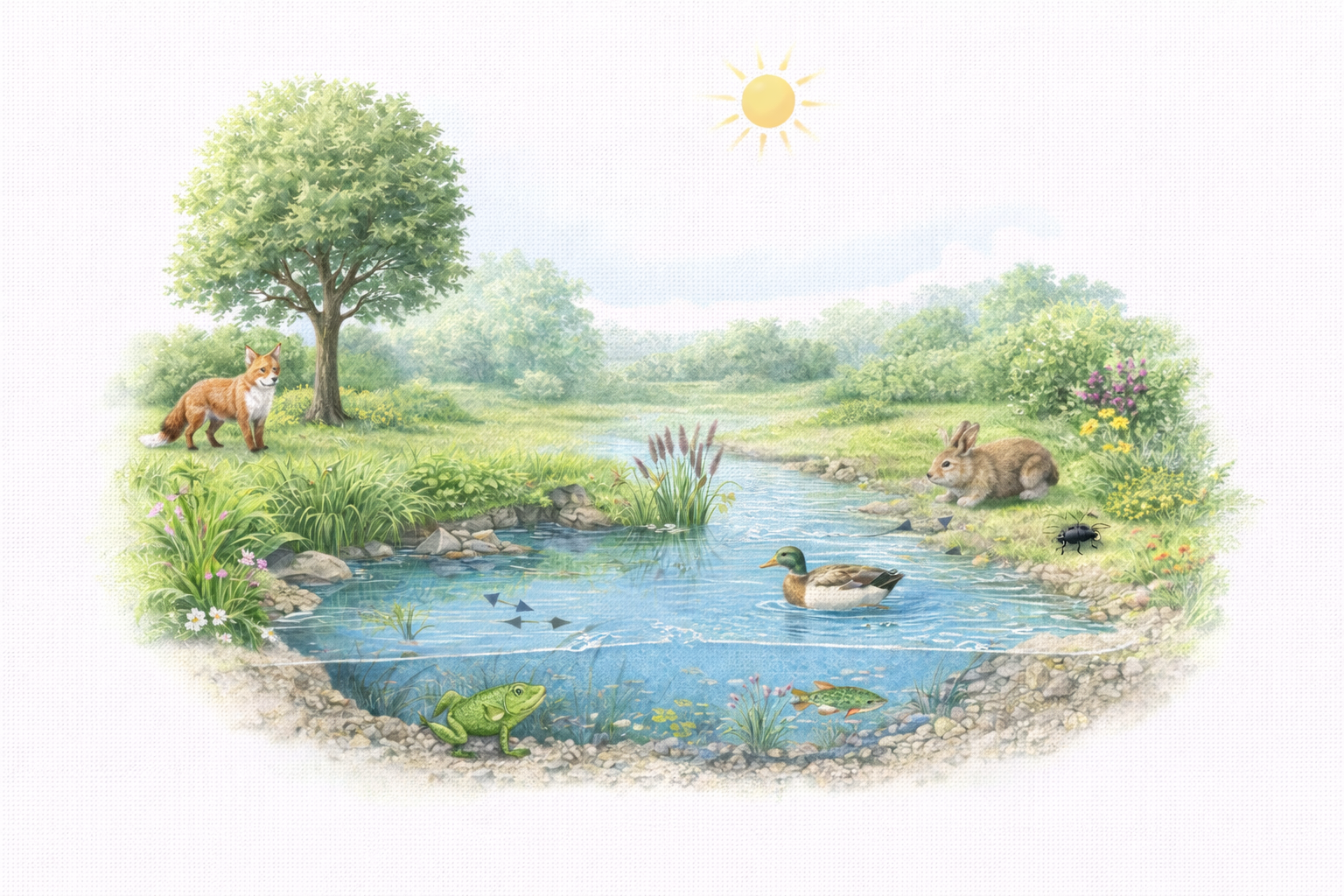
- A pond, a forest, or a field are different ecosystems, each with its own inhabitants and living conditions.
- An ecosystem is a natural system where living beings and their environment are connected through interactions.
Part 2: Interactions Between Living Beings
The living beings in an ecosystem are connected to each other by different relationships:
- Feeding relationships: a living being eats a plant or another animal.
- Competition: several living beings compete for the same resources (water, food, light, territory…).
- Associations: some species live in close relationships (beneficial or not).
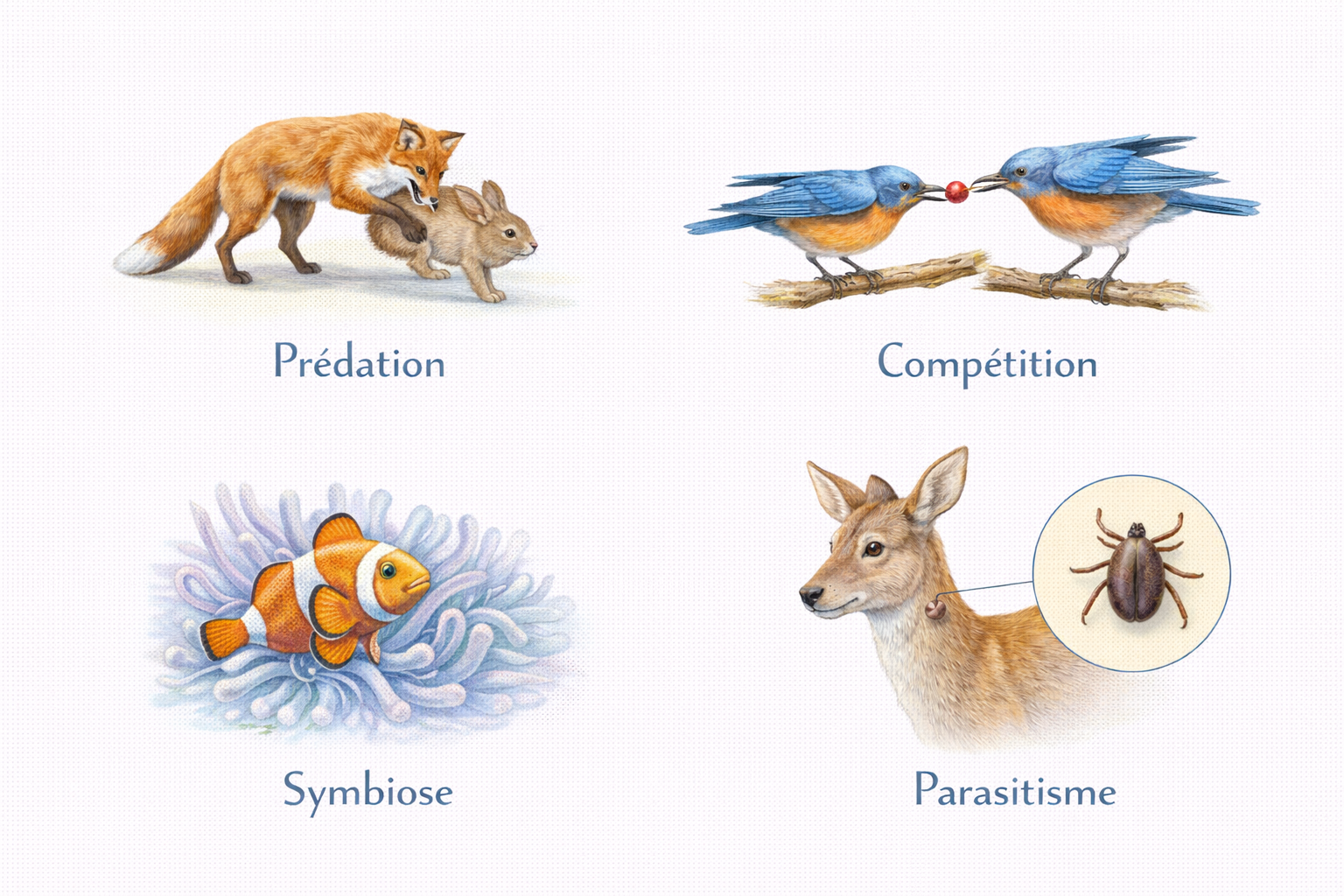
| Interaction | Description | Example |
|---|---|---|
| Predation | One living being catches and eats another. | Fox → Rabbit |
| Competition | Struggle for limited resources. | Nearby plants competing for water and light |
| Symbiosis (mutualism) | Close and lasting association, beneficial for both partners. | Lichen = algae + fungus |
| Parasitism | One organism benefits from another causing it harm. | Tick → Mammal |
- Interactions between living beings are varied (predation, competition, symbiosis, parasitism) and essential for the functioning of an ecosystem.
Part 3: Food Chains and Food Webs
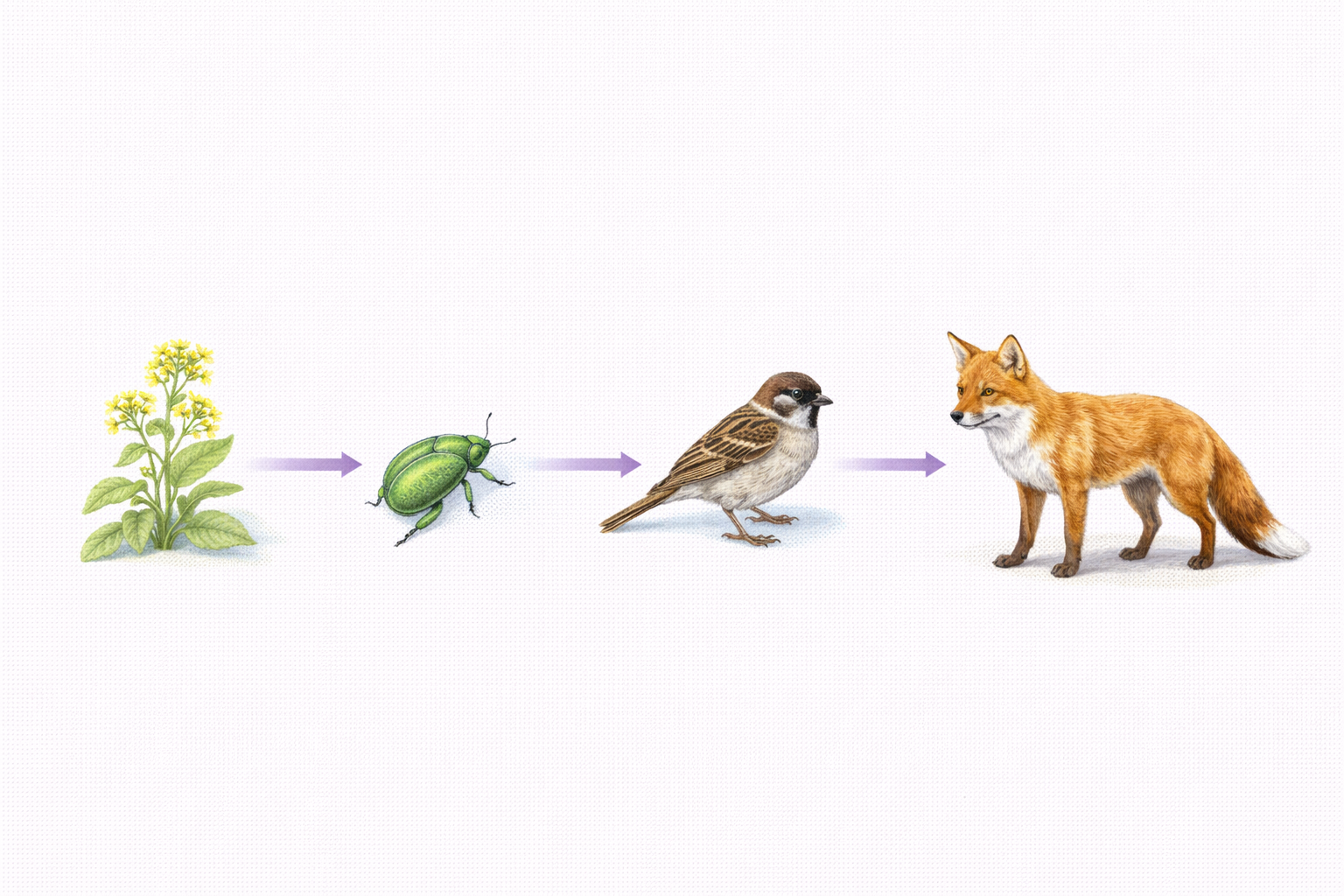
Living beings organize themselves into food chains: one organism can be the consumer of another and itself be consumed by another. Several linked chains form a food web.
- Producers (plants, phytoplankton): create organic matter through photosynthesis (using light, water, and carbon dioxide).
- Consumers: eat producers or other consumers.
- Decomposers: transform dead matter and waste into mineral elements reusable by producers.
| Role | Description | Examples |
|---|---|---|
| Producers | Create organic matter through photosynthesis. | Green plants, phytoplankton |
| Primary consumers | Herbivores that eat producers. | Insects, rabbits |
| Secondary/tertiary consumers | Carnivores that eat other consumers. | Insect-eating birds, foxes |
| Decomposers | Recycle dead matter into mineral elements. | Fungi, soil bacteria |
Plant → Insect → Bird → Fox
- Food chains show the transfer of matter and energy between living beings.
- Food webs group together multiple linked chains.
Part 4: Ecosystem Balance
We speak of balance when populations and resources remain generally stable over the long term, even if they vary over time: this is a dynamic balance.
- If a population increases too much, it can exhaust resources (food, space…).
- If a population decreases significantly, it can disturb other species (fewer prey, disappearance of a pollinator…).
Factors That Can Disturb the Balance
- Pollution
- Destruction or fragmentation of habitat
- Introduction of exotic species (sometimes invasive)
- Climate changes (temperature, droughts…)
- The balance of an ecosystem is dynamic: it depends on interactions between living beings and the environment.
- Natural or human disturbances can change this balance.
An ecosystem combines an environment (biotope) and living beings (biocenosis) that interact. Relationships (predation, competition, symbiosis, parasitism) and food webs organize the transfer of matter and energy. The balance of an ecosystem is dynamic and can be disturbed by environmental changes, pollution, habitat destruction, or introduction of invasive exotic species. Understanding these mechanisms helps protect nature better.