Electricity and Circuits
Problem — How does electricity flow in a circuit and how can we build a simple circuit?
- Understand what electric current is.
- Identify the components of a simple electric circuit.
- Know how to make a closed circuit and observe how it works.
- Discover the concepts of conductor and insulator.
- Learn about voltage (V) and current (A) at a basic level.
Part 1: Electric current
Electric current is a movement of charges through a conductor (in metals, these are mainly electrons).
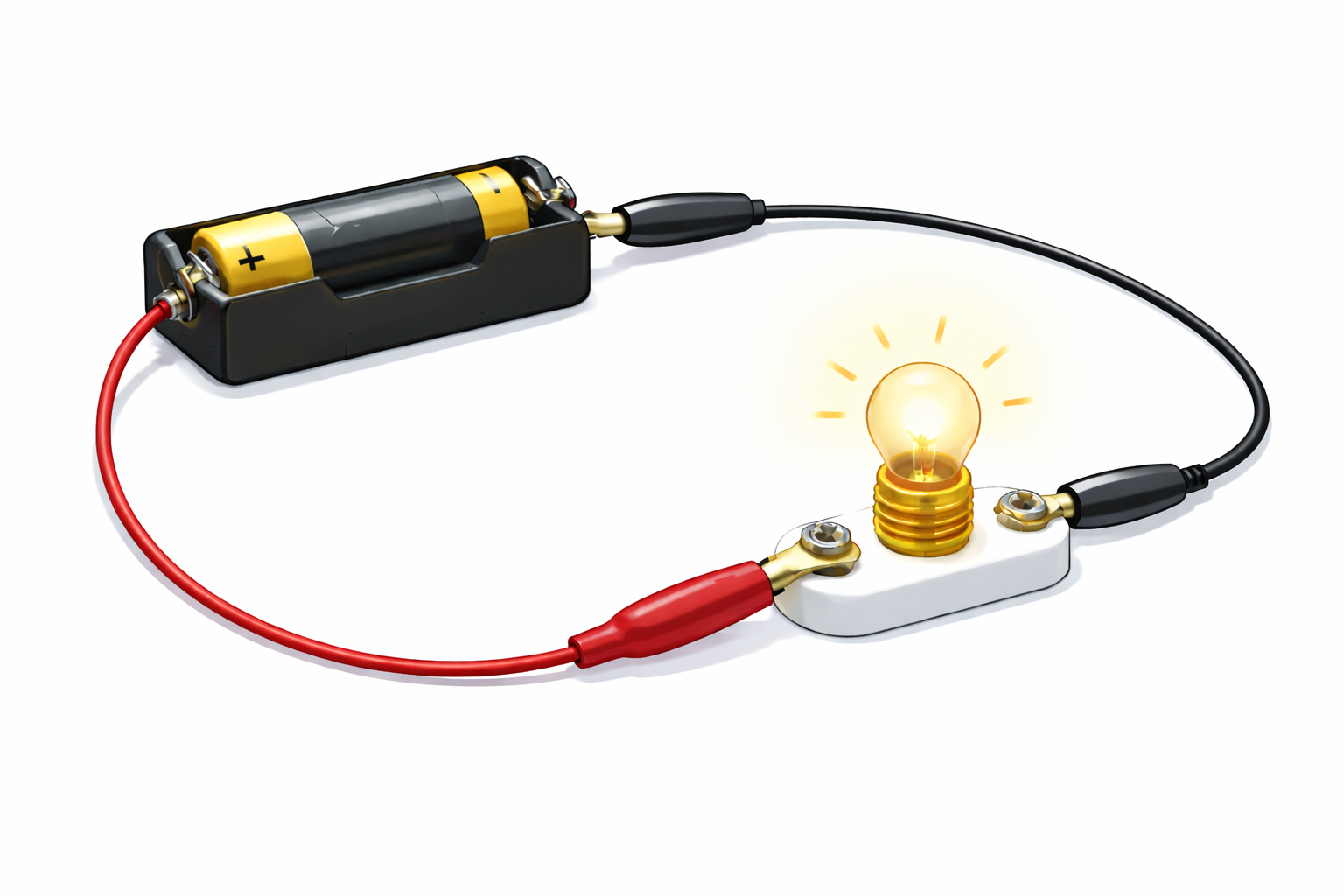
When you turn on a lamp with a battery, a current flows through the circuit and lights the bulb.
Note — In metals, current is due to the movement of electrons; in an ionic solution, it is carried by ions.
- Direction of current (conventional): from + to –.
- Direction of electrons (in a metal): from – to +.
- Current is the movement of charges.
- It enables the transfer of energy from the source to the receiver.
Part 2: Components of an electric circuit
Main Components
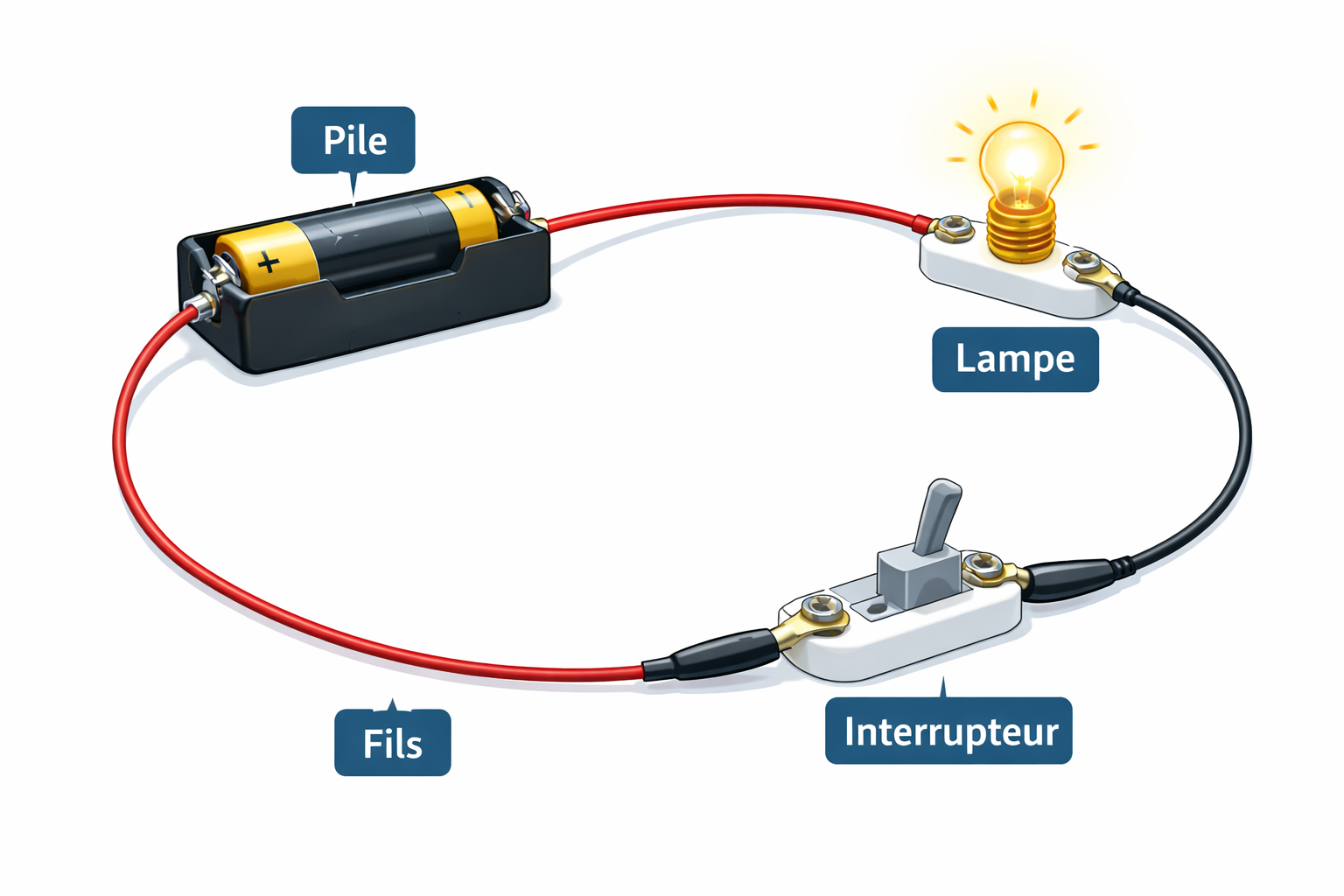
- Source: battery or generator, provides electrical energy.
- Conductors: wires that allow current to flow.
- Receiver: device that uses electrical energy (lamp, motor).
- Switch: allows opening or closing the circuit.
A simple circuit includes a battery, wires, a lamp, and a switch.
| Component | Role | Examples / Notes |
|---|---|---|
| Source | Provide electrical energy | 4.5 V battery, AA battery, lab generator |
| Conductors | Connect the circuit elements | Plastic-coated copper wires |
| Receivers | Convert electrical energy | Lamp (light), motor (movement) |
| Switch | Open/close the circuit | Button, lever, push button |
- Voltage (V): "what pushes" the charges (e.g., 4.5 V battery).
- Current (A): "what flows" in the circuit.
- Each component has a specific role in the circuit’s operation.
Part 3: Closed and open circuits
Definitions
- Closed circuit: current can flow, the receiver works.
- Open circuit: current cannot flow, the receiver does not work.
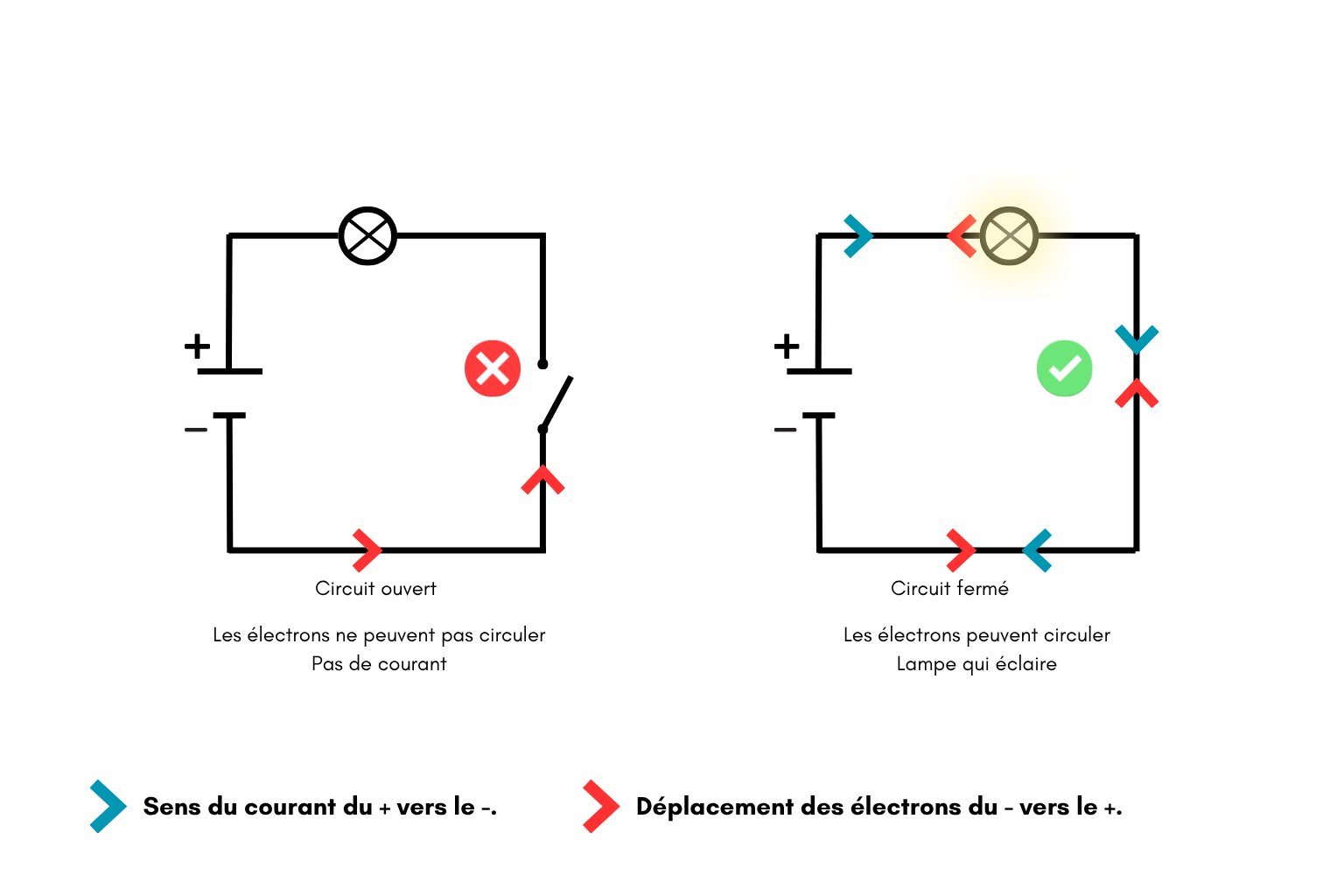
When the switch is closed, the lamp lights up; when it is open, it goes off.
| Switch | Circuit state | Lamp state |
|---|---|---|
| Closed | Closed (continuous) | On |
| Open | Open (broken) | Off |
- The circuit must be closed for current to flow.
Part 4: Conductors and insulators
Definitions
- Conductor: material that lets electric current pass (e.g., copper, aluminum, graphite).
- Insulator: material that blocks electric current (e.g., plastic, glass, dry wood).
Electrical wires are made of copper (conductor) covered with plastic (insulator).
Note — Some insulators can become conductors when they are wet (e.g., wet wood).
| Type | Common materials | Use |
|---|---|---|
| Conductors | Copper, aluminum, graphite (pencil lead) | Wires, tracks, contacts |
| Insulators | Plastic, glass, ceramic, dry wood | Coverings, supports, safety |
- In class, use a battery or lab generator, never a power outlet.
- Handle with dry hands and do not short-circuit the battery.
- Knowing conductors and insulators is essential for building safe circuits.
Electricity flows in a closed circuit thanks to an energy source. Circuit components have specific roles. Distinguishing between conductors and insulators helps understand how current flows and how to ensure safety.