Electricity in Direct Current
Problematic — How does a direct current electric circuit work and how to represent it?
How does a direct current electric circuit work and how to represent it?
- Understand what direct electric current is.
- Identify the main components of a simple electric circuit.
- Understand that a circuit must be closed for current to flow.
- Know how to represent an electric circuit using a standardized diagram.
Part 1: Direct Electric Current
Electric current corresponds to an orderly movement of electric charges in a circuit. In metallic conductors, it is the electrons that move.
In a direct current, the direction of the current always remains the same in the circuit. This is the case, for example, when using a battery or a cell.
A battery has two terminals: a positive terminal and a negative terminal. It supplies the energy needed to set the electric charges in motion within the circuit.
Example: a lamp connected to a battery will light up only if the circuit is properly closed.
Direct current is an electric current that always flows in the same direction in a circuit. It is provided by generators such as batteries or cells. To understand how an electric circuit works, it is important to remember that having an energy source is not enough: there must also be a complete path allowing the movement of electric charges. This concept is essential in 9th grade as it forms the basis for studying circuits, their components, and their representation.

Part 2: Components of an Electric Circuit
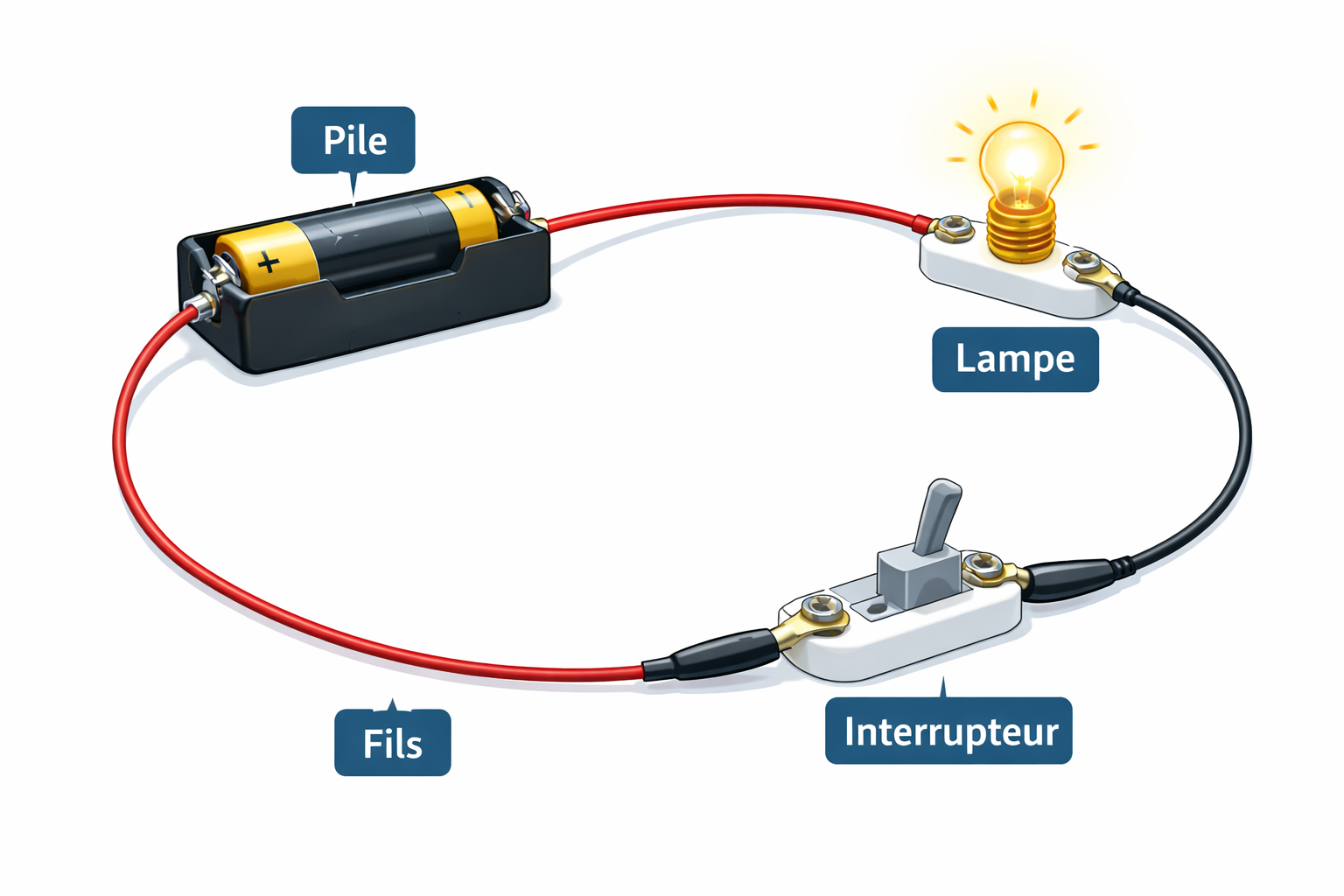
A simple electric circuit consists of several elements, each with a specific role.
Energy source: a battery or generator that provides the electrical energy necessary for the circuit to operate.
Conductors: electric wires that connect the different components and allow current to flow.
Receivers: devices that use electrical energy to produce an effect, for example light, motion, or heat.
Switch: a component that allows opening or closing the circuit to either stop or allow current flow.
| Component | Role | Examples |
|---|---|---|
| Energy source | Provides electrical energy | Battery, generator |
| Conductors | Allow current flow | Electrical wires |
| Receivers | Use electrical energy | Lamp, motor |
| Switch | Opens or closes the circuit | Simple switch |
Each component in an electric circuit has a precise function. The energy source provides the energy, the conductors ensure the connection between elements, the receivers convert electrical energy into another useful effect, and the switch controls the flow of current. Understanding the role of each of these elements helps not only to better read a circuit but also to logically and accurately build or correct a setup.
Part 3: Representation of an Electric Circuit
In physics, components of a circuit are not drawn as they appear in reality: standardized symbols are used. This allows everyone to read a schematic the same way.
Thus, the electrical schematic represents the essential components of the circuit and the connections between them, without trying to reproduce their actual shape.
For current to flow, the circuit must be closed. If the circuit is open, no current flows and the receiver does not work.
The switch plays an important role here:
- open switch: the circuit is broken, current does not flow;
- closed switch: the circuit is complete, current can flow.
| Rule / Concept | Explanation |
|---|---|
| Standardized symbols | Allow representing components universally |
| Closed circuit | Necessary for current to flow |
| Open switch | Breaks the circuit and prevents current flow |
| Closed switch | Completes the circuit and allows current flow |
The electrical schematic is a simplified but essential language to represent a circuit. Thanks to standardized symbols, we can quickly understand the organization of a setup without needing a photo or realistic drawing. In 9th grade, it is essential to know that a circuit must be closed to function, and that the switch controls this closure. Mastering the electrical schematic thus allows moving from observing a real setup to a clear and usable scientific representation.
Direct current corresponds to an orderly flow of electric charges in one direction only, generally supplied by a battery or cell. A simple electric circuit includes an energy source, conductors, one or more receivers, and often a switch. For current to flow, the circuit must be closed. Representation through electrical schematics, based on standardized symbols, is essential to analyze, understand, and correctly build a circuit. By mastering these concepts, students gain the foundational knowledge needed to study more complex circuits and the electrical behavior of various dipoles.