Energy and Chemical Transformations
Key Question — How does energy play a role during chemical transformations?
How does energy play a role during chemical transformations?
- Understand that chemical reactions involve exchanges of energy.
- Identify exothermic and endothermic reactions.
- Know that energy can appear in different forms (heat, light, electricity...).
- Understand that a reaction may require a starting energy (activation energy).
Part 1: Energy in Chemical Reactions
During a chemical transformation, bonds between atoms break and new bonds form. Breaking bonds requires energy, while forming bonds releases energy.
Energy is a quantity that measures a system's ability to cause a transformation (exchange heat, perform work, emit light, etc.).
| Step | Effect on Energy |
|---|---|
| Breaking bonds | Requires energy |
| Forming bonds | Releases energy |
The energy balance of a reaction depends on comparing the energy used to break bonds and the energy released when new bonds form.
- Chemical reactions always involve energy exchanges.
- Breaking bonds consumes energy; forming bonds releases energy.
Part 2: Exothermic and Endothermic Reactions
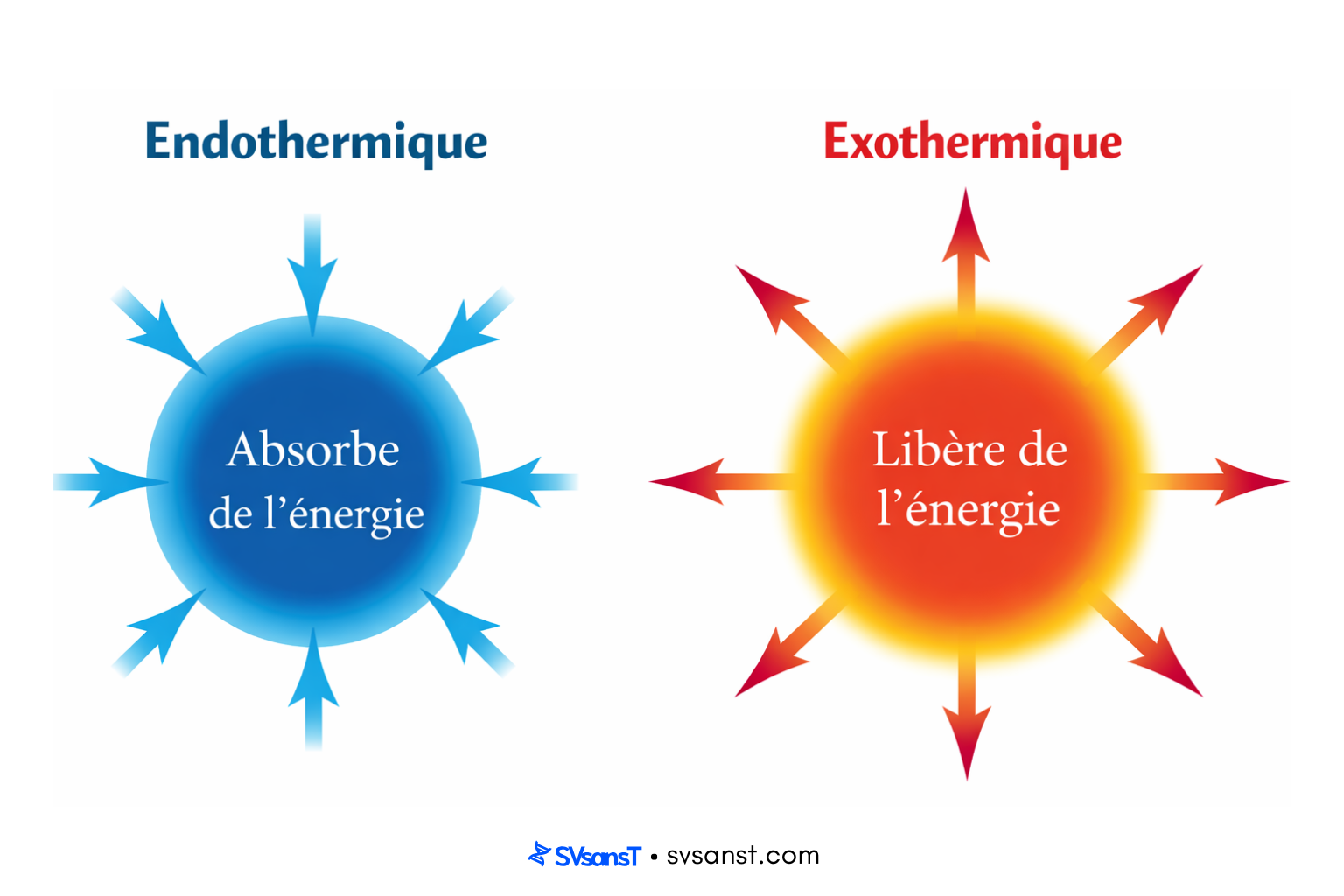
Exothermic reaction: releases energy to the surroundings (often as heat, sometimes also light). Example: combustion.
Endothermic reaction: absorbs energy to occur. Example: photosynthesis, which requires light energy.
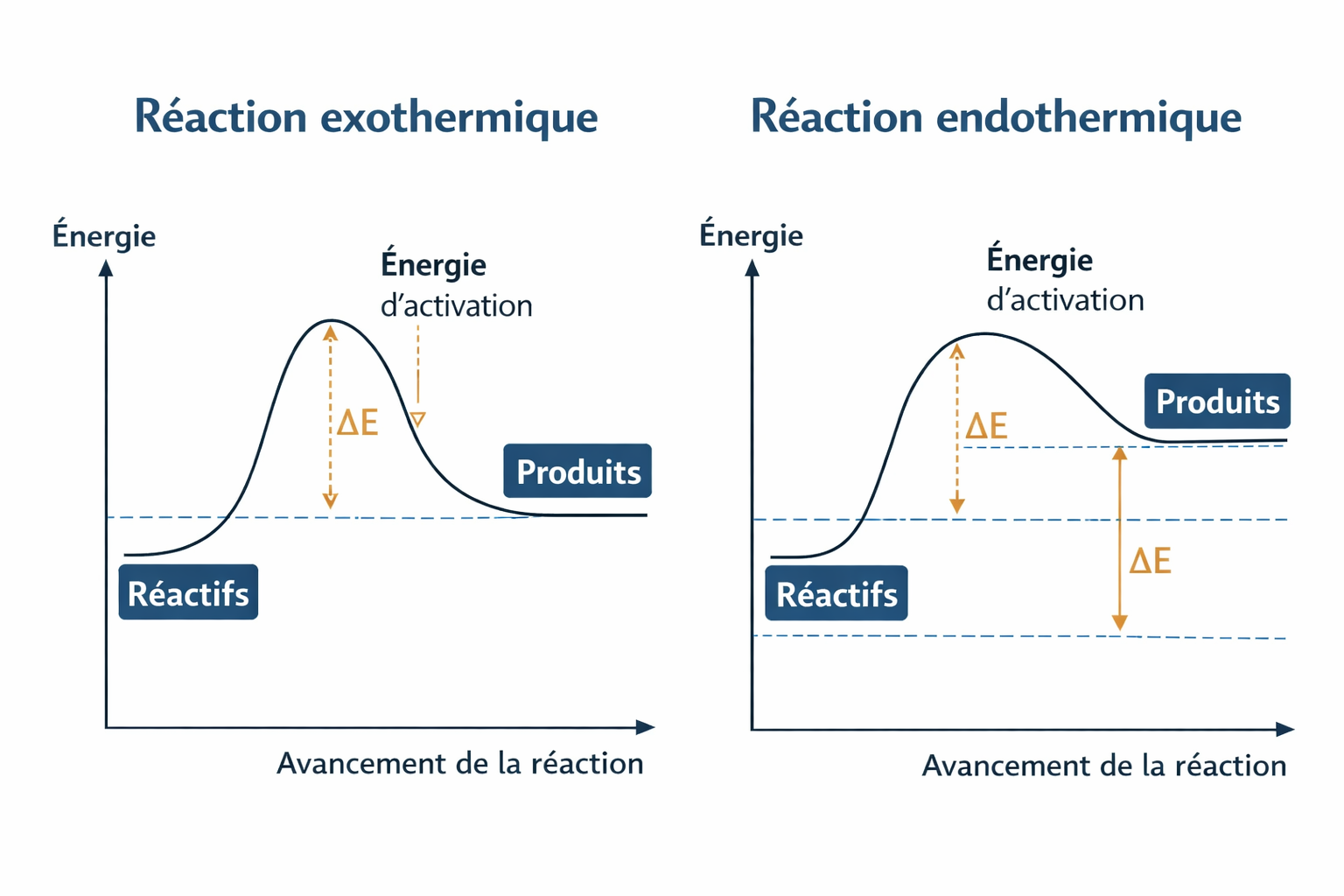
| Type of Reaction | Energy Exchange | Common Sign | Example |
|---|---|---|---|
| Exothermic | Energy release (heat, light...) | Surrounding temperature often rises | Combustion |
| Endothermic | Energy absorption | Surrounding temperature often drops | Photosynthesis (light energy) |
Even an exothermic reaction may need an initial “push”: this is the activation energy (for example, a spark to start combustion).
- Exothermic: energy released to the surroundings.
- Endothermic: energy absorbed from the surroundings.
- A reaction may require activation energy to begin.
Part 3: Forms of Energy in Chemical Transformations
The energy exchanged during a reaction can appear as heat, light, sound, or electrical energy.
Measuring temperature often helps detect thermal energy exchange (though this is not the only sign).
| Form of Energy | How to Observe It? |
|---|---|
| Heat | Temperature change |
| Light | Light emission |
| Sound | Noise (explosion, crackling...) |
| Electrical | Current/voltage produced or consumed |
- The exchanged energy can take multiple forms: thermal, light, sound, electrical.
- A temperature change is a common sign, but not the only one.
Chemical transformations always involve energy exchange: some reactions release energy (exothermic), others absorb it (endothermic). Energy can appear in different forms (heat, light, electricity...). Even an exothermic reaction may require activation energy to start.