Geometric Optics
Key Question — How does light propagate and how can we explain the phenomena of shadow, reflection, and refraction?
- Understand the straight-line propagation of light in a homogeneous, transparent medium.
- Study the phenomena of shadow and penumbra.
- Discover the laws of reflection and refraction of light.
- Learn to use light rays to model these phenomena.
Part 1: The Straight-Line Propagation of Light
Light travels in a straight line in a homogeneous and transparent medium.
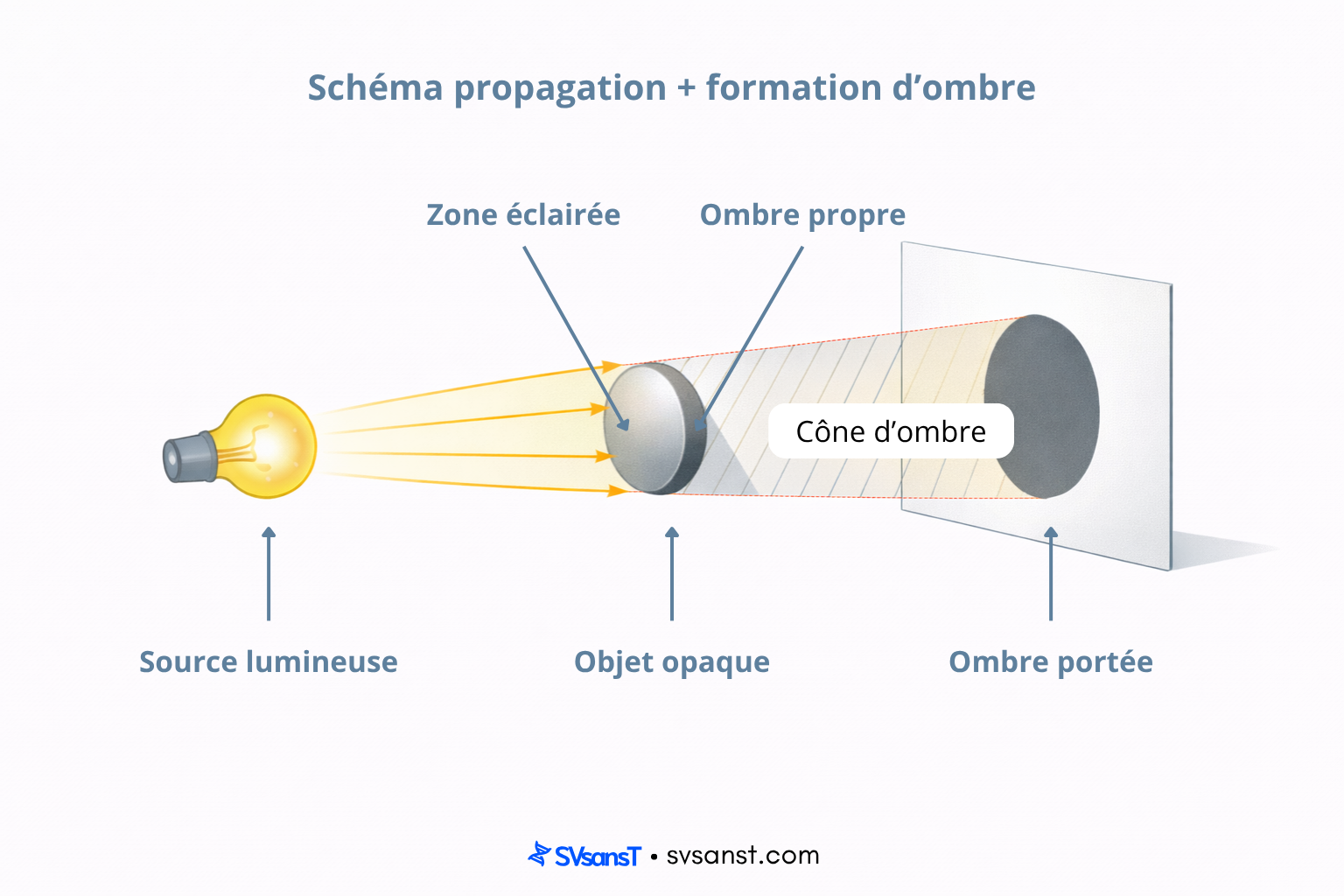
When you turn on a lamp in a room, the light shines directly on objects in its path. When an opaque object lies in this path, it blocks the light and creates a shadow zone behind it.
The straight-line propagation of light is a fundamental idea in geometric optics. It simply explains why some objects are illuminated while others are not, and why shadows appear behind opaque objects. In 8th grade, this property serves as a basis for understanding several phenomena studied later, such as shadow, reflection, and refraction.
Part 2: Shadow and Penumbra
Definitions
- Shadow: area where light from the source is completely blocked by an opaque object.
- Penumbra: area where light is only partially blocked.

When the Sun shines on a tree, a shadow is cast on the ground. Around this shadow, there may be a less dark area called the penumbra because the Sun is an extended source and not a single point of light.
| Zone | Illumination | Cause |
|---|---|---|
| Shadow | No direct light from the source | The object blocks the entire source |
| Penumbra | Partial light | The object blocks only part of the source |
The phenomena of shadow and penumbra can be explained by the straight-line propagation of light. If the light source is a point source, a sharp shadow is mainly produced. If the source is extended, like the Sun or a large lamp, a penumbra often appears around the main shadow. Understanding this difference helps explain many everyday observations, like softer or sharper shadows or eclipses.
Part 3: Reflection of Light
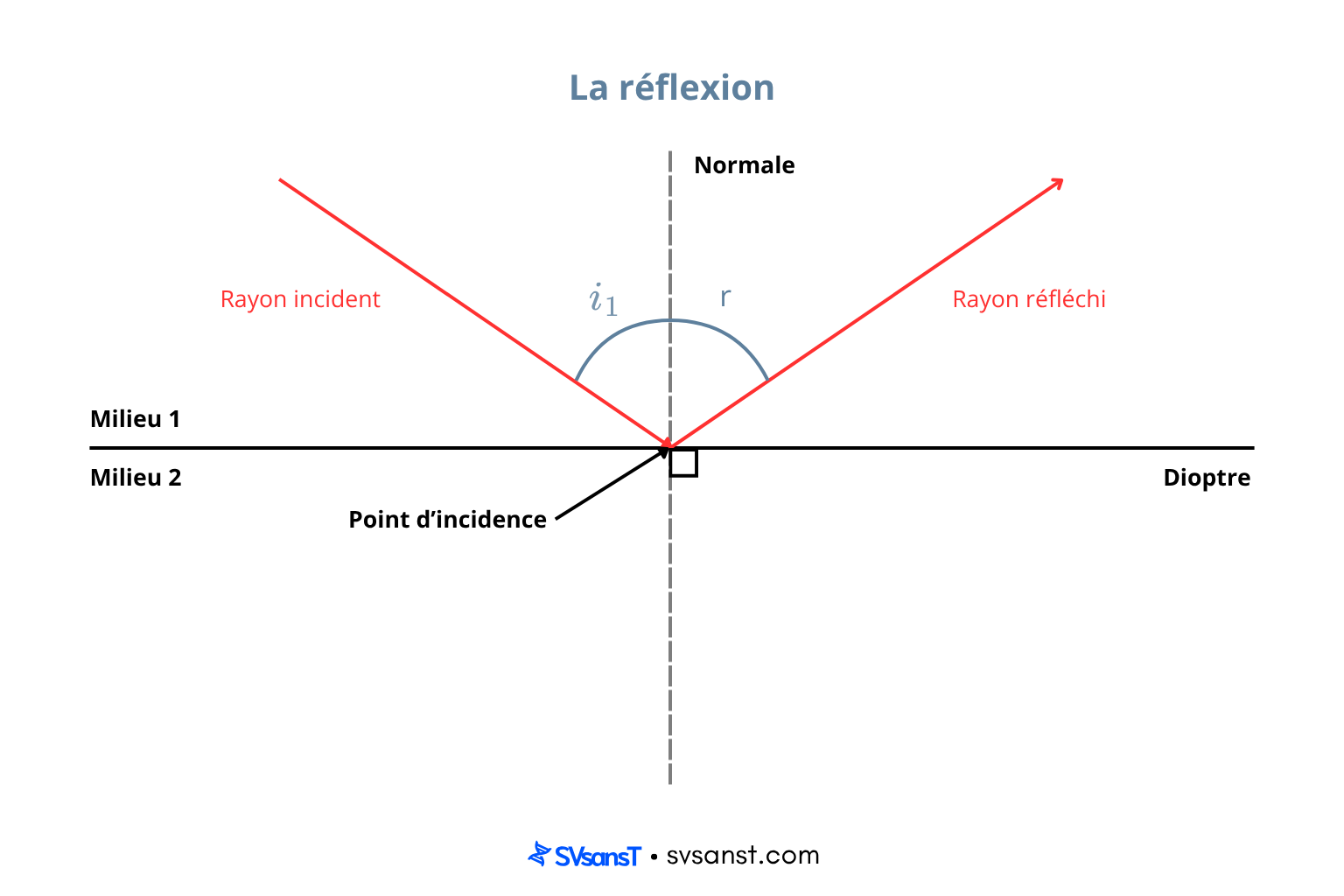
Reflection is the phenomenon where light is bounced back by a surface.
Laws of Reflection
- The incident ray, the reflected ray, and the normal at the point of incidence all lie in the same plane.
- The angle of incidence is equal to the angle of reflection. These angles are measured relative to the normal.
- Specular reflection: on a smooth surface, like a mirror, light is reflected in an orderly way and can form an image.
- Diffuse reflection: on a rough surface, like a wall, light is reflected in many directions.
A mirror reflects light according to the laws of reflection, allowing one to see their reflection. In contrast, a white wall also reflects light but diffusely: it lights up the room without forming a clear image.
Reflection is a very common phenomenon: it explains both how mirrors work and how rooms are illuminated. The laws of reflection allow us to precisely predict the direction of a light ray reflected by a surface. In 8th grade, it is important to distinguish between specular reflection, which produces an image, and diffuse reflection, which lights without forming a sharp image.
Part 4: Refraction of Light
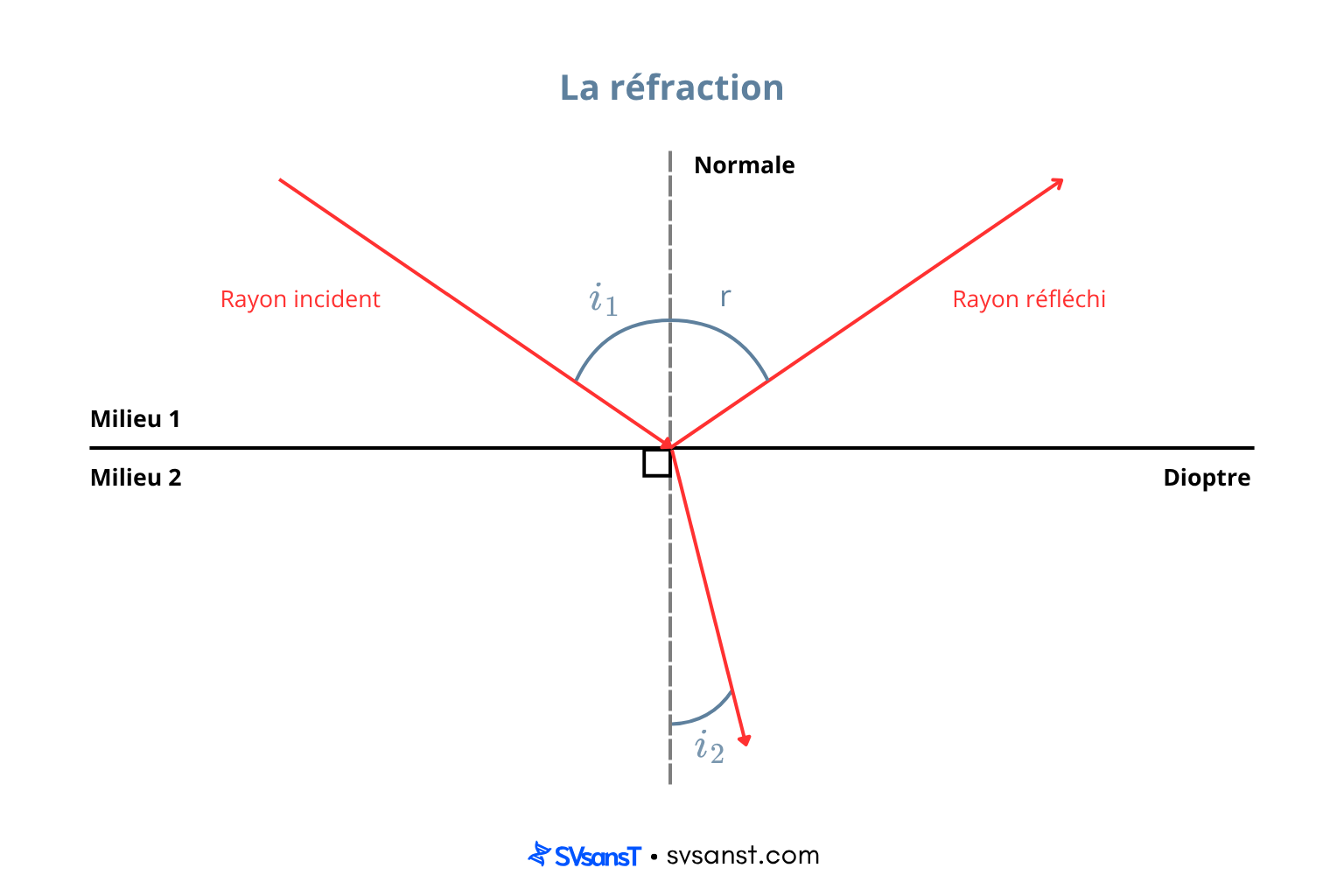
Refraction is the bending of light when it passes from one transparent medium to another.
- If light passes from a medium where it travels faster to one where it travels slower, like from air to water or glass, the ray moves closer to the normal.
- If it passes from a slower medium to a faster one, like from water or glass to air, the ray moves away from the normal.
A stick dipped in water appears broken or shifted at the surface. This is due to refraction: light from the stick changes direction when passing from water to air before reaching the eye.
Refraction shows that light doesn’t always travel in a straight line when it changes medium. At the interface of two transparent media, it can bend, causing sometimes surprising visual effects. This explains why some objects look shifted, distorted, or broken when viewed through water or glass. Refraction also plays an important role in the function of lenses and many optical instruments.
Light travels in a straight line in a homogeneous and transparent medium, which explains the formation of shadows and penumbras. When it meets a surface, it can be reflected; when it changes medium, it can be refracted, that is, bent. These phenomena follow precise rules and can be modeled using light rays. Geometric optics thus provides simple tools to understand many everyday observed phenomena and prepares for studying more complex applications in physics.