Biodiversity and the Environment: Understanding the Richness of Life
Question — Why is biodiversity important for the balance of nature and our environment?
Why is biodiversity important for the balance of nature and our environment?
- Understand what biodiversity is.
- Identify the different levels of biodiversity.
- Know why it is important to protect biodiversity.
- Discover examples of actions to preserve it.
Part 1: What is Biodiversity?
Biodiversity refers to the variety of life on Earth: animals, plants, fungi, and microorganisms.
It also includes the diversity of habitats where they live and the relationships between them.
Biodiversity is the richness and variety of life (living beings, habitats, and relationships) in a given area or on a planetary scale.
- Biodiversity includes living organisms, their habitats, and their interactions.
Part 2: Levels of Biodiversity
Genetic Biodiversity
This is the diversity of genes (and therefore traits) within a single species.
Example: different varieties of apples, or individuals of the same species with different colors or coats.
Species Biodiversity
This is the variety of different species in an environment.
Example: in a pond: frogs, dragonflies, aquatic plants, snails…
Ecosystem Biodiversity
This is the diversity of natural habitats (forests, oceans, grasslands, rivers…) and the relationships between living beings.
Example: a forest does not work the same way as a grassland or a coral reef.
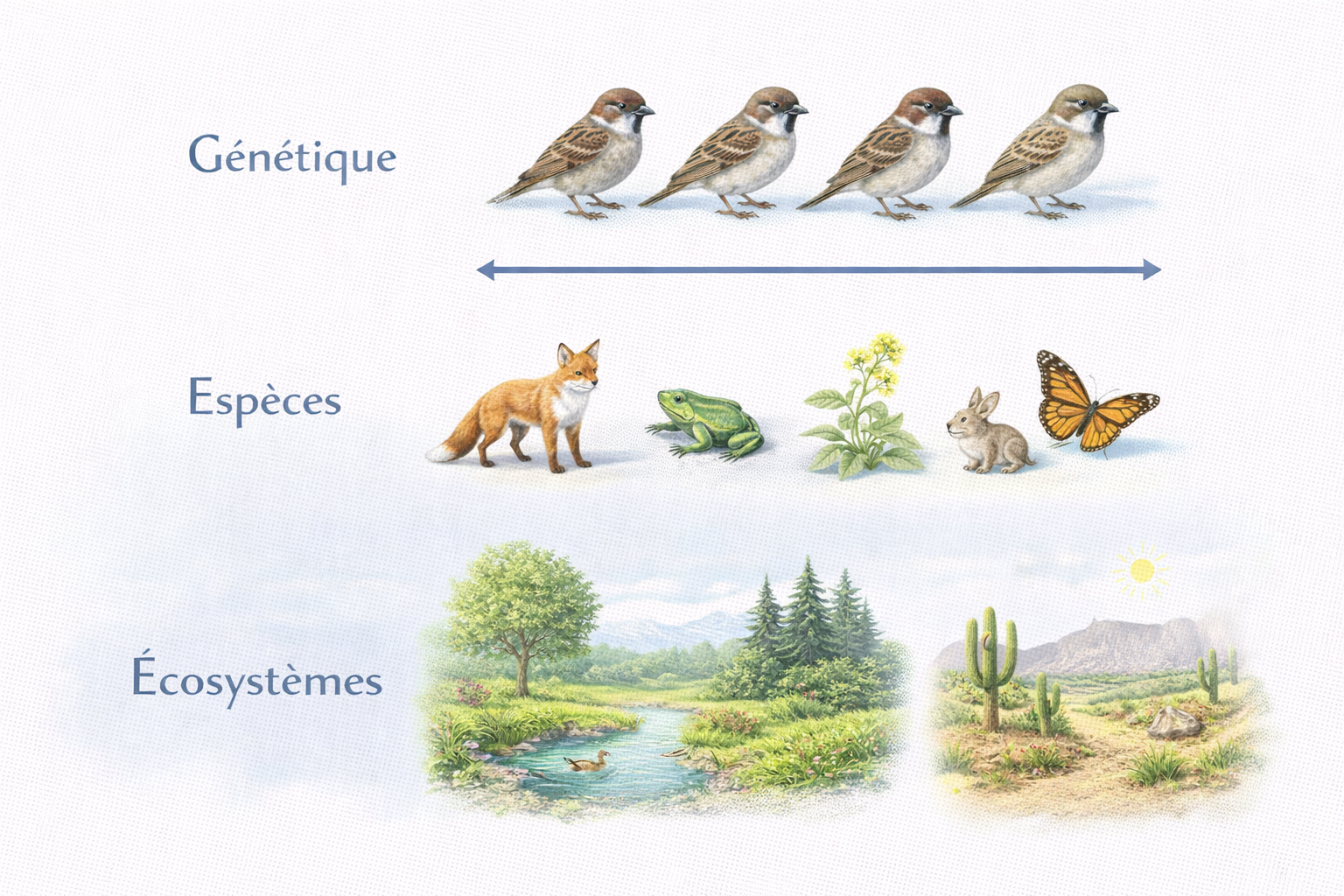
| Level | According to the text |
|---|---|
| Genetic | Diversity of genes within a species |
| Species | Variety of different species in an environment |
| Ecosystems | Diversity of natural habitats and relationships between living beings |
- Biodiversity is observed at several levels: genes, species, and ecosystems.
Part 3: Why Protect Biodiversity?

Biodiversity contributes to the functioning of ecosystems: oxygen production, pollination, matter recycling, population balance…
It also provides essential resources: food, medicines, materials.
An ecosystem functions thanks to a dynamic balance: populations fluctuate, but the whole can remain stable if the environment is not too disturbed.
Main Threats
- Destruction or fragmentation of habitats (urbanization, deforestation…)
- Pollution (plastics, pesticides, waste…)
- Climate change (temperature rise, droughts…)
- Invasive exotic species (introduced by humans and can unbalance the environment)
- Overexploitation (overfishing, excessive harvesting…)

| Key Idea | According to the course |
|---|---|
| Role | Contributes to ecosystem functioning and species survival |
| Resources | Food, medicines, materials |
| Threats | Habitat destruction, pollution (and other pressures) |
| Challenge | Preserving the environment and our future |
- Protect and restore habitats (reserves, replanting, wetlands).
- Connect habitats with ecological corridors to allow movement.
- Reduce pollution and pesticide use.
- Consume responsibly (avoid waste, choose sustainable products).
- Biodiversity is essential for ecosystem functioning and provides resources.
- It is threatened by various human activities and climate change.
- Protecting it means preserving our environment and our future.
Biodiversity is the richness of life (genes, species, ecosystems) and their interactions. It is essential for the functioning of natural environments and provides many resources. Understanding its levels and threats (pollution, habitat destruction, invasive species, climate change…) allows us to act to preserve it and protect our environment.