The Needs of Living Things
Issue — What are the essential needs all living things must meet to live and grow?
What are the essential needs all living things must meet to live and grow?
- Identify the essential needs of living things.
- Understand why these needs are vital for life.
- Connect these needs to vital functions.
Part 1: Why Do Living Things Have Needs?
All living things require certain conditions and resources to live, grow, reproduce, and carry out their vital functions.
A vital need is a condition or resource indispensable for the survival of a living thing.
If a vital need is not met, the living thing does not function properly, may weaken, and eventually die. For example, without water, food, or a suitable environment, cells cannot function normally.
Living things cannot survive just anywhere. They need specific resources and conditions to carry out vital functions such as feeding, breathing, growing, and reproducing. A vital need is therefore not just "comfort": it is something essential to maintaining life. Understanding this helps explain why some living things can only live in specific environments and why they become vulnerable when their environment changes too much.
Part 2: The Essential Needs of Living Things
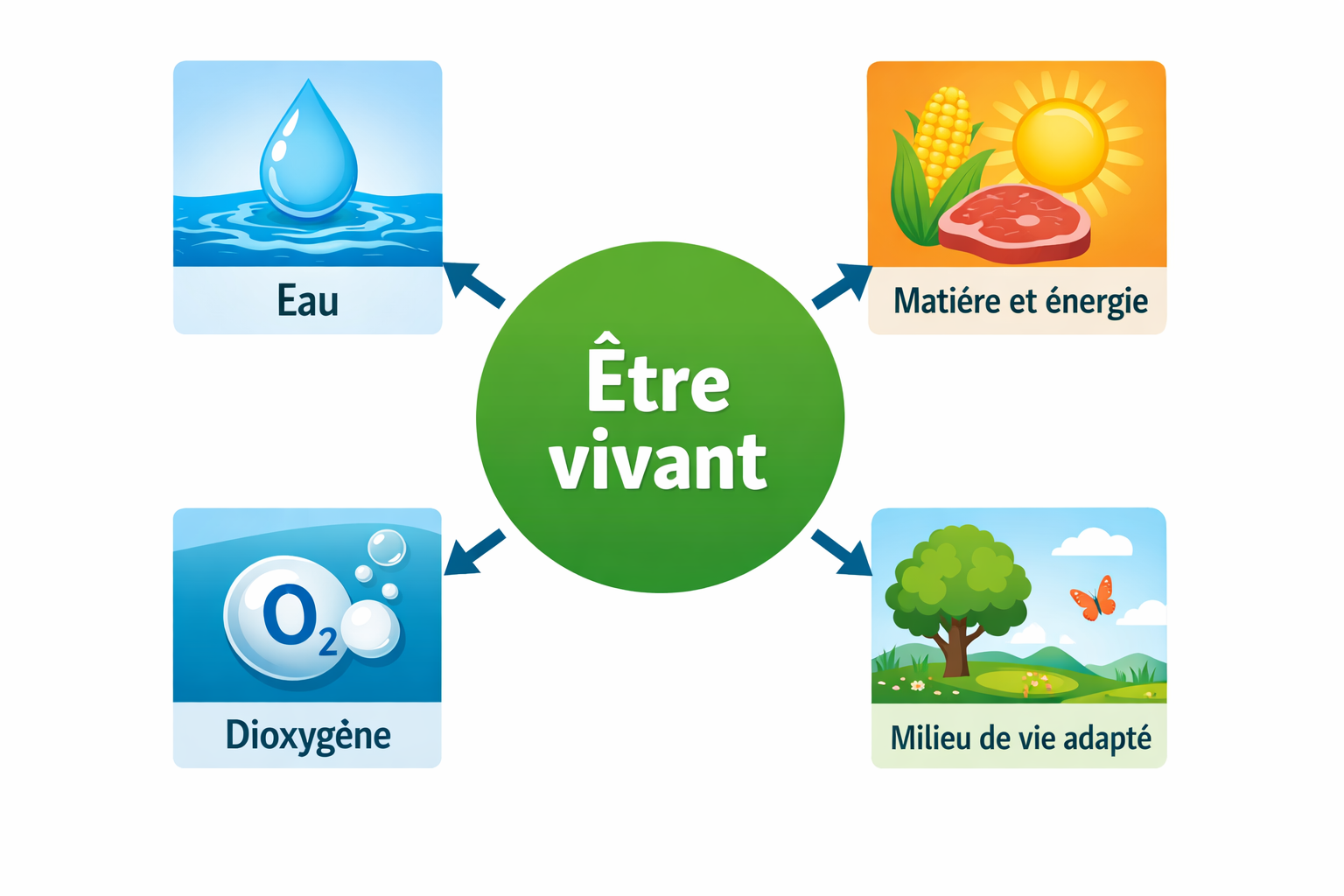
1. Water
Water is essential for many chemical reactions taking place in cells.
It also enables the transport of substances within the organism, for example in blood in animals or in sap in plants.
All living things need water, even those living in very dry environments.
Plants absorb water through their roots; animals drink it or also obtain it by eating.
2. Food (matter and energy)
Food provides matter and energy necessary for growth, repair, and the functioning of cells.
Green plants produce their organic matter through photosynthesis, using water, carbon dioxide, mineral salts, and light.
Animals must consume other living beings, or parts of them, to obtain this organic matter.
3. Oxygen (O₂)
Oxygen is required for cellular respiration in many living things. This respiration produces the energy essential for life.
Note: some microorganisms can live without oxygen. They are said to live in anaerobic environments.
4. A suitable living environment
Each living thing needs an environment that suits it: temperature, light, humidity, available space, type of soil or water, presence of other living beings, etc.
A significant change in these conditions can threaten its survival or limit its development.
Living things have several essential needs. Water is indispensable for cell function and substance transport. Matter and energy are needed to grow and function. Many living things also need oxygen for cellular respiration. Finally, no living thing can survive long-term without an environment suited to its characteristics. These needs are directly linked to vital functions: nutrition, exchanges with the environment, growth, and life maintenance.
Part 3: Adaptations of Living Things to Their Needs
Living things have developed adaptations, that is, characteristics that help them meet their needs in their environment.
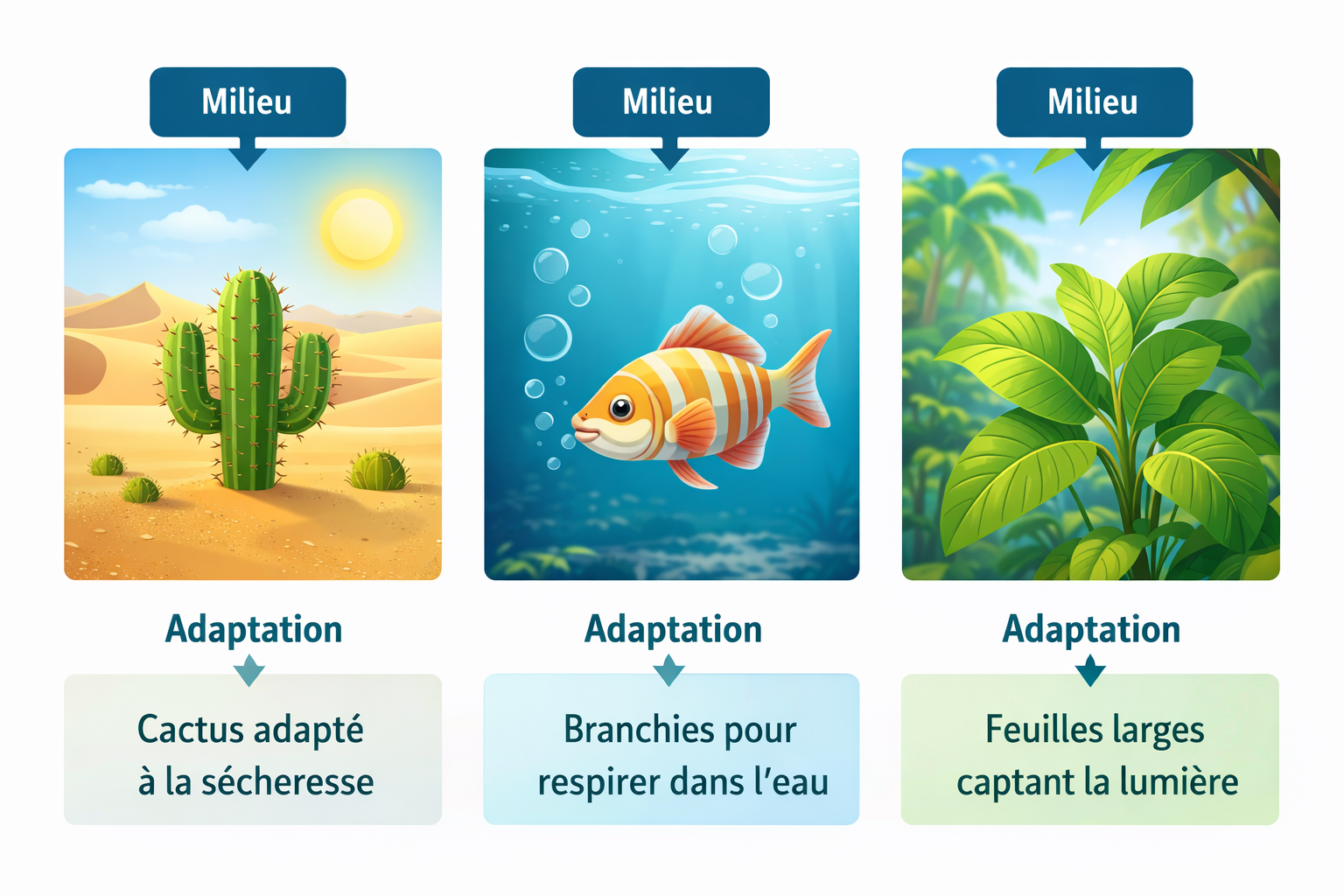
Examples:
- Cacti have wide or deep roots to capture water in the desert.
- Many aquatic animals have gills to absorb dissolved oxygen in water.
- Some tropical forest plants have large leaves to capture more light.
These adaptations can concern body shape, organism functioning, or behavior. They help living things better use the resources available in their habitat.
Living things do not meet all their needs in the same way. They have adaptations that help them live better in their environment. These adaptations can help find water, capture light, breathe, or feed. They increase chances of survival in a given environment. Understanding these adaptations shows that living things' needs are universal, but the solutions to meet them vary greatly by species and habitat.
All living things have essential needs: water, a source of matter and energy, and a suitable living environment. Many also need oxygen for cellular respiration. These needs are vital to perform vital functions such as nutrition, exchanges with the environment, growth, and maintaining life. To survive, living things have adaptations that enable them to better meet these needs in their environment. Studying living things' needs thus helps better understand the diversity of living things and their connections with their habitat.