The Cell: Structure and Function
Question — What is a cell? How is it organized and what are its functions in living things?
What is a cell? How is it organized and what are its functions in living things?
- Understand the concept of the cell as the unit of life.
- Identify and describe the different parts of a cell.
- Explain the main functions of the cell.
- Differ between animal and plant cells.
Part 1: The Cell, Unit of Life
The cell is the basic unit of life: all living beings are made up of one or more cells. We say that the cell is the structural unit of life because it builds organisms, and the functional unit because it performs the functions necessary for life.
Note: viruses are not made of cells.
A human is made up of billions of cells, while a bacterium is an organism made of only one cell.
History and Discovery
The cell was observed in the 17th century thanks to the microscope. In 1665, Robert Hooke observed small cavities in a slice of cork which he called "cells" because they reminded him of small rooms.
A microscope is an instrument that allows observing very small objects invisible to the naked eye.
The cell is the smallest living structure capable of carrying out essential life functions. All known living beings are made up of one or more cells, showing that the cell is a fundamental common point in the living world. The invention of the microscope allowed the discovery of this organization invisible to the naked eye and deeply changed the understanding of life. In 6th grade, it is important to remember that the cell is the common basis for all living beings, even if their number of cells and their organization can be very different.
Part 2: The Structure of the Cell
The Main Parts of a Cell
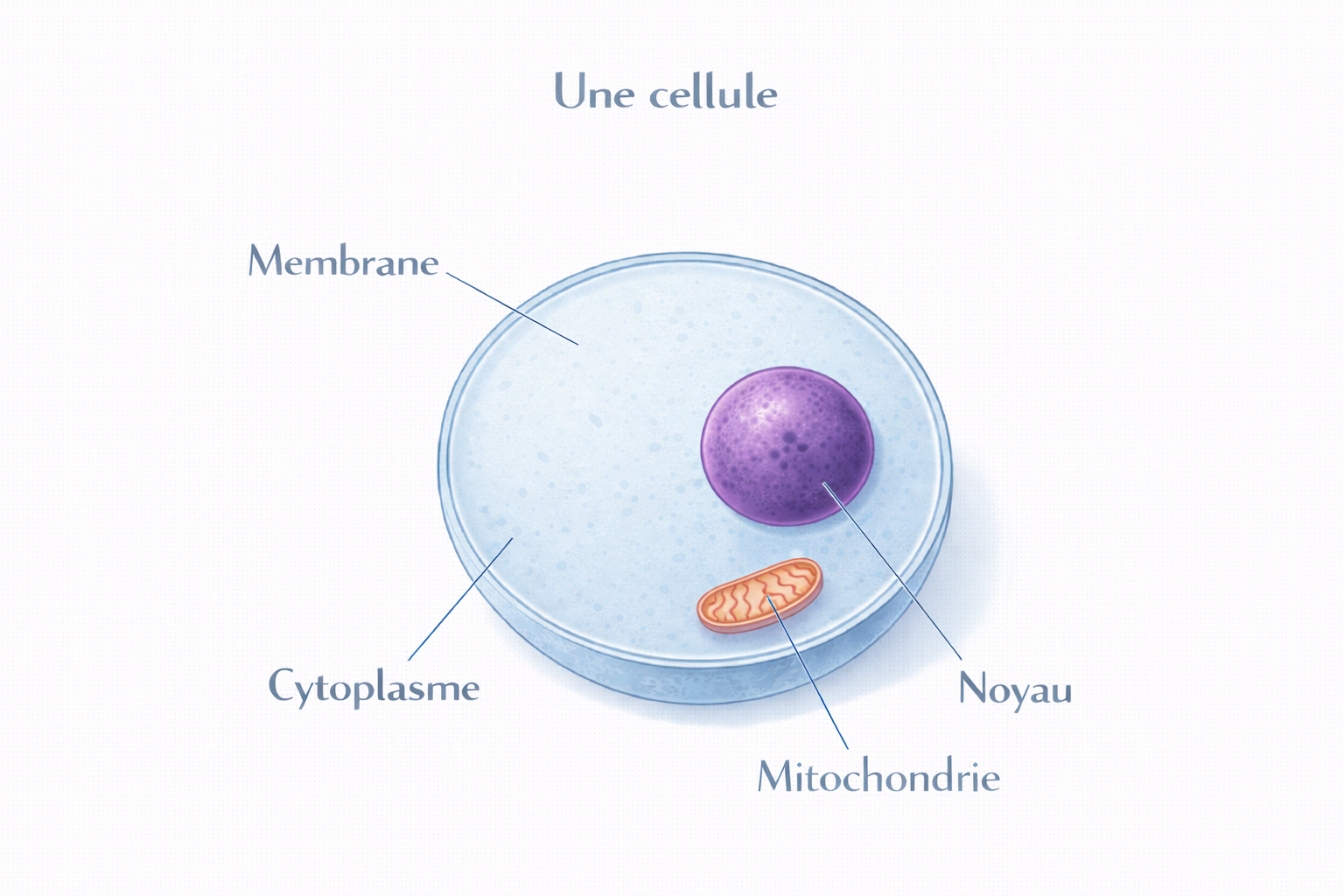
- It is a thin envelope that surrounds the cell.
- It protects the cell and controls exchanges with the outside.
- It allows entry of certain useful substances and exit of certain wastes.
- It is a gel-like substance inside the cell.
- It contains different elements of the cell.
- Many important chemical reactions occur there.
- It is a structure present in many living cells, especially in animals and plants.
- It contains the genetic material, that is DNA.
- DNA carries information necessary for the cell’s functioning and reproduction.
They are specialized structures that perform specific functions within the cell.
For example:
- Mitochondria help release energy usable by the cell.
- Ribosomes participate in protein production.
- Other organelles exist in some cells, but in 6th grade it is mainly important to understand that every part of the cell has a role.
Difference Between Animal and Plant Cells
| Element | Animal Cell | Plant Cell |
|---|---|---|
| Cell Wall | Absent | Present, rigid, protects and helps give shape |
| Chloroplasts | Absent | Present, enable photosynthesis |
| Vacuole | Small or absent | Large central vacuole, mainly stores water and other substances |
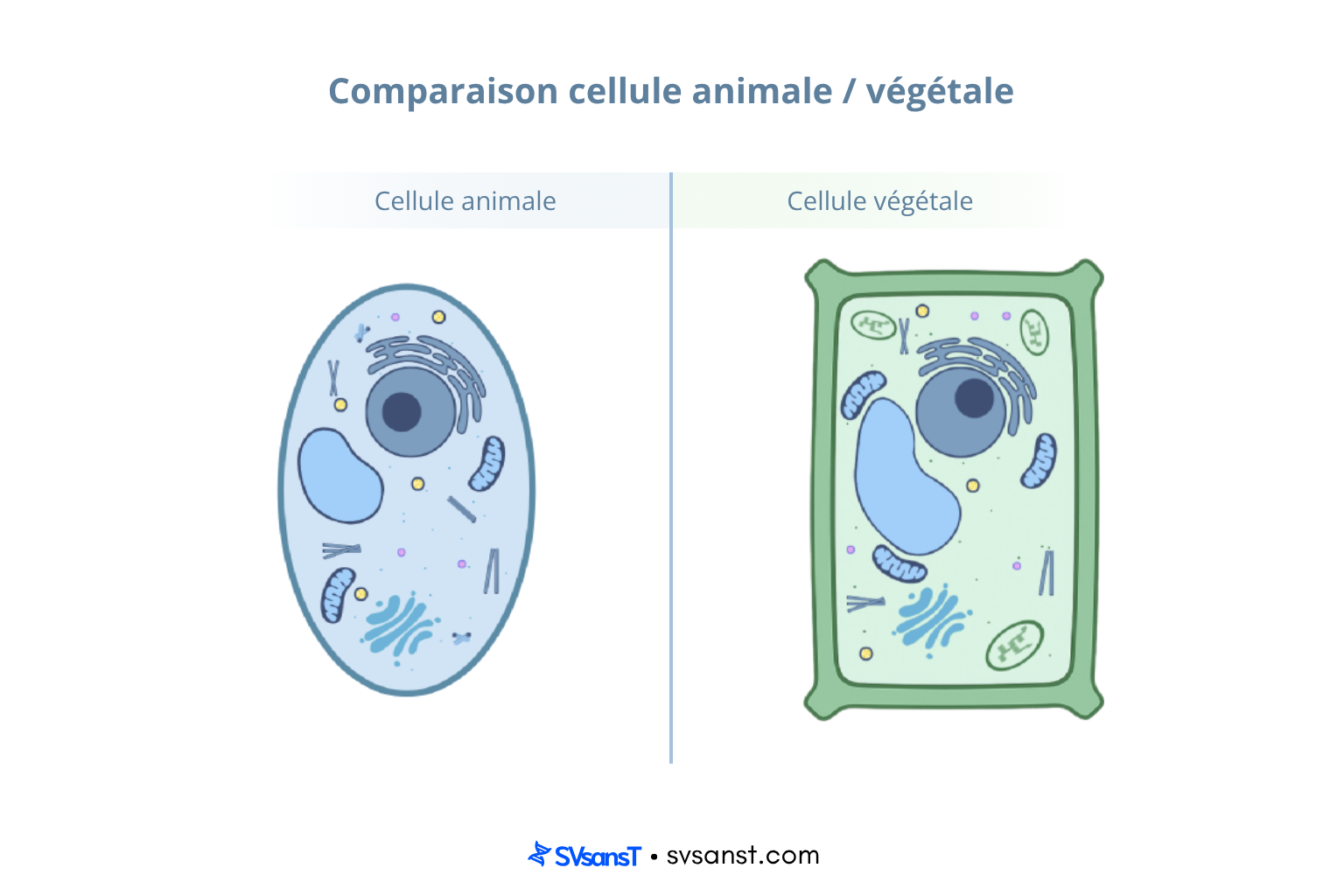
- Cell Wall: a rigid layer that surrounds the membrane of plant cells.
- Chloroplasts: organelles containing chlorophyll, which capture light to perform photosynthesis.
- Vacuole: a liquid-filled compartment, important for storage and maintaining the shape of the plant cell.
A cell is not just a "small bag": it has a precise organization. The membrane limits it and controls exchanges, the cytoplasm contains the different internal elements, and the nucleus holds the DNA in many cells. Some specialized structures, called organelles, also perform specific functions. Animal and plant cells share common features, but plant cells also have a cell wall, chloroplasts, and a large vacuole. These differences explain why they do not have exactly the same shape or function.
Part 3: The Functions of the Cell
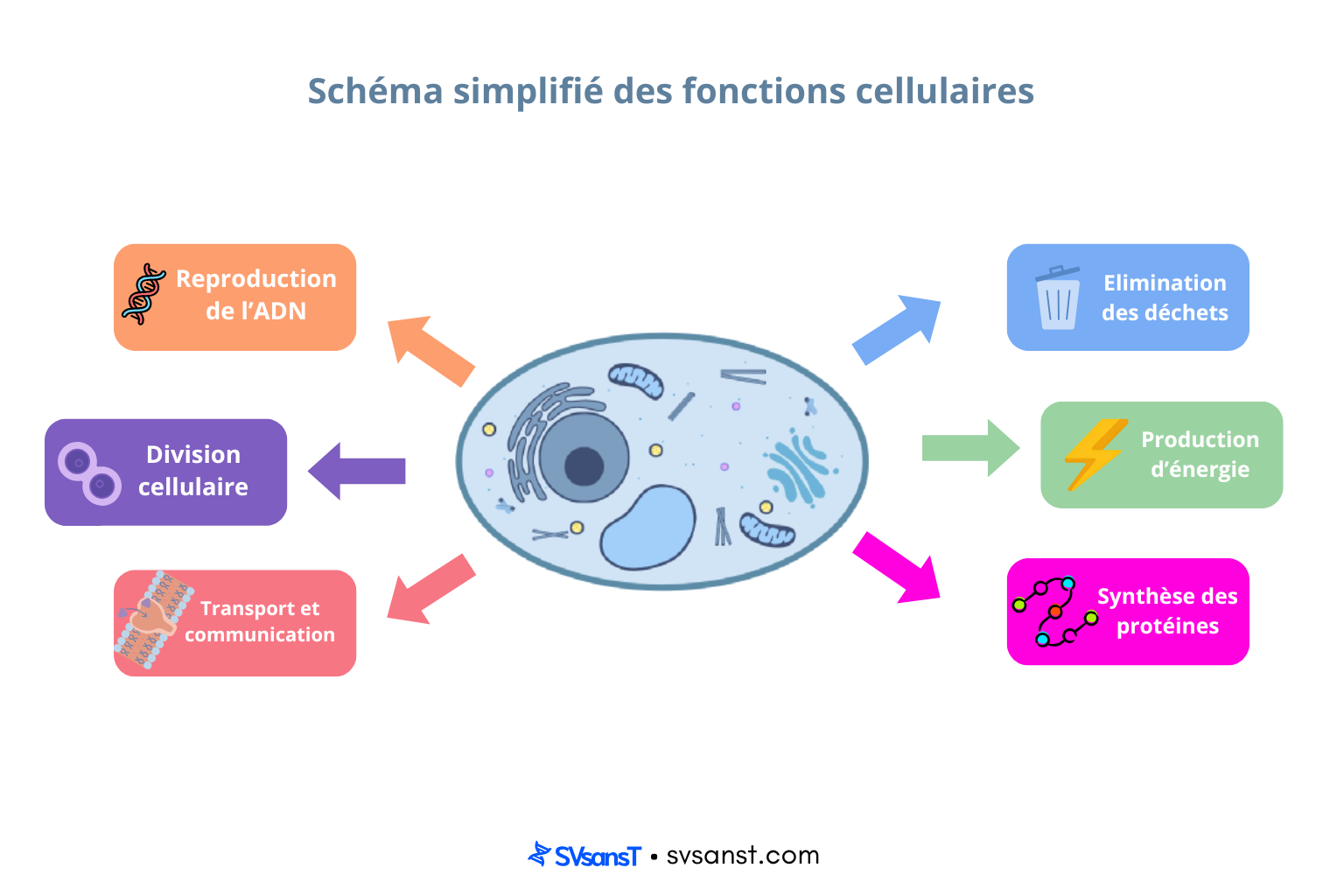
The cell takes in substances necessary for its survival, such as water, mineral salts, and nutrients. It uses them to make its own material and to function.
Many cells use oxygen and nutrients to release usable energy. This energy is essential for all cellular activities. This process also produces carbon dioxide and water. In many cells, this occurs mainly in the mitochondria.
The cell can divide to form two daughter cells, usually identical. This allows growth, tissue repair, and, for single-celled organisms, reproduction.
The cell expels unnecessary or sometimes toxic substances. This helps maintain proper functioning.
In the human body, skin cells regularly renew themselves thanks to cell division. Muscle cells use energy released by cellular respiration to enable movement.
A cell is alive because it carries out several essential functions. It takes in material from its environment, produces energy to function, divides to ensure growth or renewal, and removes its waste. These functions are not reserved for the whole organism: they already exist at the cellular level. Understanding this helps us see that a living being's functioning actually relies on the activity of many cells.
The cell is the basic unit of life: it is the smallest living structure capable of performing vital functions. It includes a membrane, cytoplasm, and often a nucleus containing DNA, as well as different specialized structures. Animal and plant cells share a common organization, but plant cells also have a cell wall, chloroplasts, and a large vacuole. A cell takes in material, releases energy, divides, and removes wastes. Understanding the cell therefore helps to better understand the functioning of all living beings.