Landscapes and Their Formation
Main question — How are landscapes formed and what natural and human phenomena transform them over time?
- Define what a landscape is and learn to "read" its elements.
- Identify external agents (water, wind, ice, gravity) that shape landforms.
- Discover the role of internal phenomena (Earth movements, volcanism) in forming some landforms.
- Understand erosion, transport, sedimentation, and the impact of human activities.
Part 1: What is a landscape? Reading and describing
A landscape is what we observe from a given place: it results from the combination of natural elements (landforms, water, vegetation, rocks) and human developments (roads, crops, buildings).
Reading a landscape
- Landforms: plain, plateau, valley, mountain.
- Waters: rivers, lakes, coastlines (cliffs, beaches, dunes).
- Rocks/soils: rock type, soil thickness.
- Human traces: farming, quarries, dams, towns.
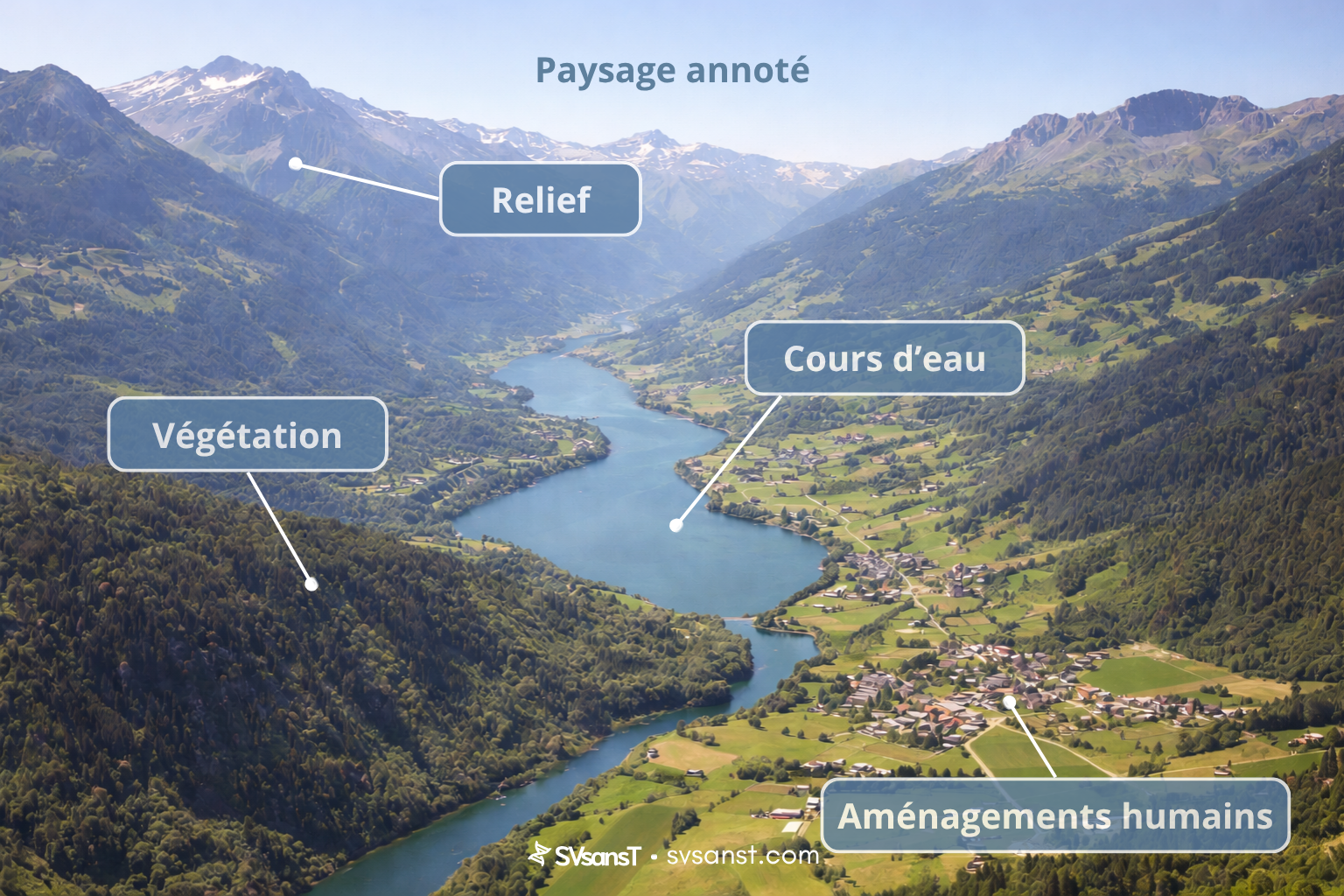
| Element | Natural / Human | Clue to observe |
|---|---|---|
| V-shaped valley | Natural | Steep slopes carved by a river |
| Coastal cliffs | Natural | Rock fronts attacked by waves |
| Terraced fields | Human | Stepped slopes for agriculture |
| Quarry | Human | Extraction zone, piles of displaced rocks |
- A landscape is a mix of natural elements and human developments.
- It can be described by visible clues (landforms, water, rocks, human activities).
Part 2: External agents — erosion, transport, and deposition
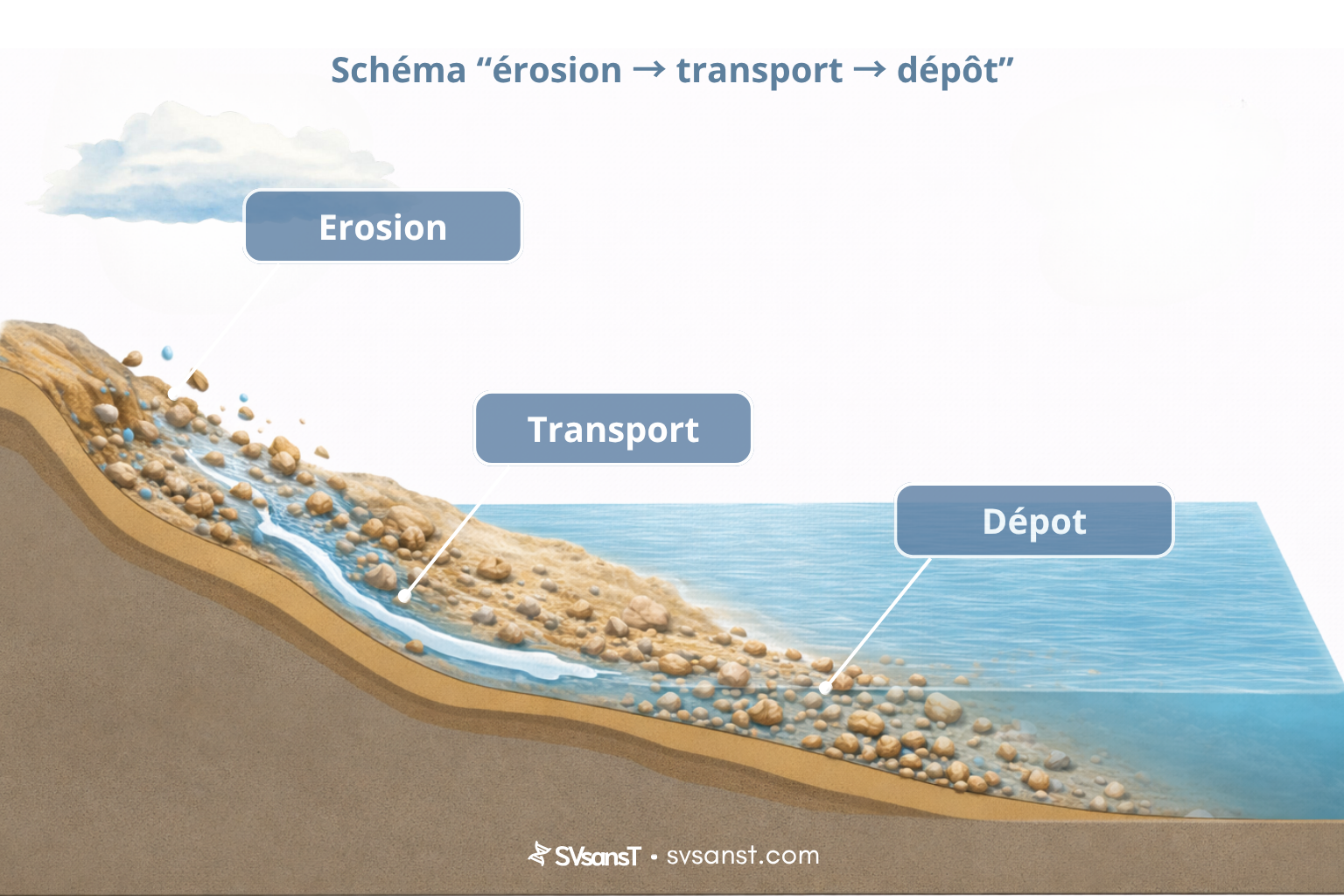
On the Earth's surface, landscapes evolve due to external agents (water, wind, ice, gravity). They cause erosion (wearing away of rocks), followed by transport and deposition of materials.
| Agent | Main action | Landform types | Examples |
|---|---|---|---|
| Water (rivers) | Carves, transports, deposits | V-shaped valleys, meanders, deltas | River valley, floodplain |
| Ice (glaciers) | Pulls and polishes rocks | U-shaped valleys, moraines | Alpine glacial landforms |
| Wind | Mostly moves sand | Dunes | Deserts, sandy coasts |
| Gravity | Makes materials slide or fall | Rockfalls, landslides | Unstable slopes |
| Water + rocks | Can dissolve some rocks (e.g., limestone) | Cavities, limestone landforms | Limestone landscapes |
- A river carves a valley and deposits alluvium in the plain.
- A glacier carves a U-shaped valley and leaves moraines (rock piles).
- Waves wear down a cliff and make the coastline recede.
- External agents shape landforms through erosion → transport → deposition.
Part 3: Internal phenomena that build landforms
Inside the Earth, forces can lift or deform the crust. This can form mountains, cause earthquakes, and feed volcanism.

| Internal phenomenon | What happens | Landforms / effects |
|---|---|---|
| Folding | Rocks bend | Mountain ranges |
| Faults | Rocks break and move | Escarpments, earthquakes |
| Volcanism | Molten rock rises and can erupt as lava | Volcanoes, new rocks |
A mountain can form by internal movements, then be gradually worn down by water, ice, and wind: a landform is thus the result of building then shaping.
- Internal phenomena can create landforms (mountains, volcanoes).
- External agents then shape them.
These phenomena are linked to plate tectonics: Earth’s surface is divided into large plates that move very slowly.
Part 4: Sedimentation, geological time, and human actions
Sedimentation and time
- The products of erosion are transported then deposited: they form layers (strata).
- Superposition: usually, a newer layer covers an older one.
- Over time, these layers can form sedimentary rocks and sometimes contain fossils.
| Stage | Process | Result |
|---|---|---|
| Erosion – transport | Wearing and movement | Sediments (blocks → gravel → sand → mud) |
| Deposition | Current loses energy | Successive layers |
| Transformation | Pressure and "gluing" of grains | Sedimentary rocks |
Human actions and risks
- Developments: dams, dikes, earthworks — they modify watercourses and sediment movement.
- Exploitation: quarries, extraction — they locally change landforms.
- Risks: floods, coastline retreat, landslides — prevention through monitoring and planning.
- Over long periods, erosion and deposits transform landscapes.
- Human actions can speed up or limit some changes.
Landscapes result from the interaction between internal phenomena (formation of some landforms, volcanoes) and external agents (water, ice, wind, gravity). Erosion, transport, and sedimentation transform landforms over long times. Human activities also modify these dynamics: observing and understanding landscapes helps better prevent some risks.