Matter and Its States
Problem — How can we recognize and understand the different states of matter we encounter every day?
How can we recognize and understand the different states of matter we encounter every day?
- Know the three main states of matter: solid, liquid, and gas.
- Be able to describe the characteristics of each state.
- Understand the main changes of state of matter.
Part 1: What is Matter?
Matter is everything that takes up space and has mass. Around us, almost everything is made of matter: water, air, rocks, objects, food, and even our bodies. Even when we can't see it well, like air, matter is still there.
Matter can exist in different forms called states.
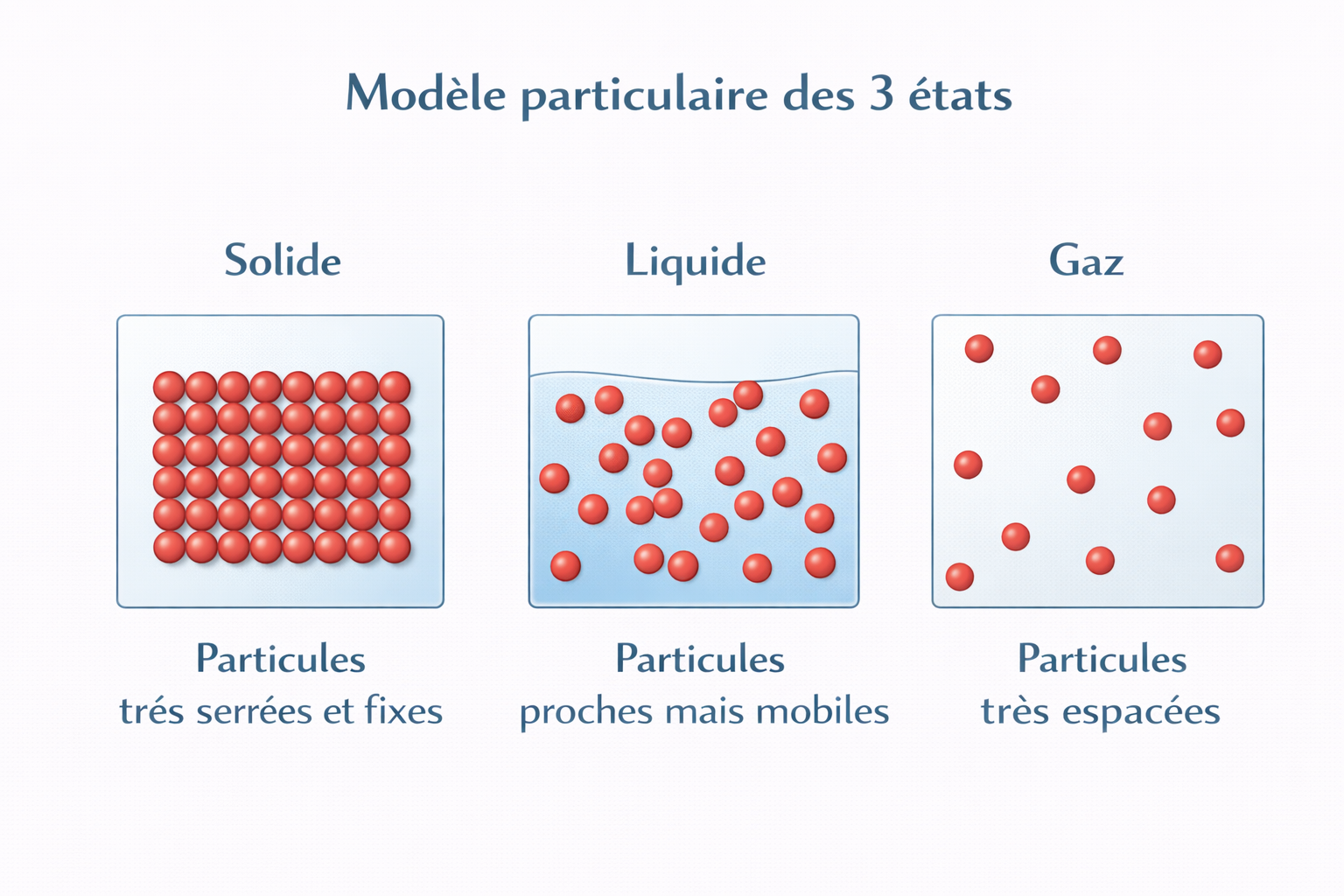
To explain the behavior of matter, we often use a simple model: we imagine that it is made of very small particles. This model helps us understand why a solid keeps its shape, why a liquid flows, and why a gas fills all the available space.
Matter is everywhere in our environment. It occupies space and has mass, even when it is hard to see, like air. To better understand its behavior, we use a model in which matter is made of very small particles. This model helps explain the different states of matter and their properties.
Part 2: The Three States of Matter
Solid State
A solid has a fixed shape and a fixed volume. This means it keeps its shape even if we change its container. In the particle model, particles are very close to each other and only vibrate around their positions. Examples: an ice cube, a stone, an eraser.
Liquid State
A liquid has a fixed volume but no fixed shape. It takes the shape of the container holding it. In the particle model, particles stay close but can move past each other. Examples: water, milk, fruit juice.
Gaseous State
A gas has no fixed shape and no fixed volume. It spreads out to fill all available space. In the particle model, particles are very far apart and move in all directions. Examples: air, oxygen gas, water vapor.
Water vapor is an invisible gas. The “white cloud” seen above a pot of boiling water is not the vapor itself but very fine liquid water droplets formed when the vapor cools.
| State | Shape / Volume | Particle arrangement | Examples |
|---|---|---|---|
| Solid | Fixed shape and volume | Very close, vibrate without moving freely | Ice cube, stone |
| Liquid | No fixed shape, fixed volume | Close, can slide past each other | Water, fruit juice |
| Gas | No fixed shape or volume | Very far apart, move freely | Air, water vapor |
The three states of matter differ by their shape, volume, and how their particles are arranged. A solid keeps its shape and volume, a liquid keeps its volume but takes the shape of its container, and a gas has neither fixed shape nor volume. These differences help us easily recognize the state of matter in everyday life and explain its behavior.
Part 3: Changes of State
Matter can change from one state to another when it gains or loses thermal energy, usually when it is heated or cooled. These transformations are called changes of state.
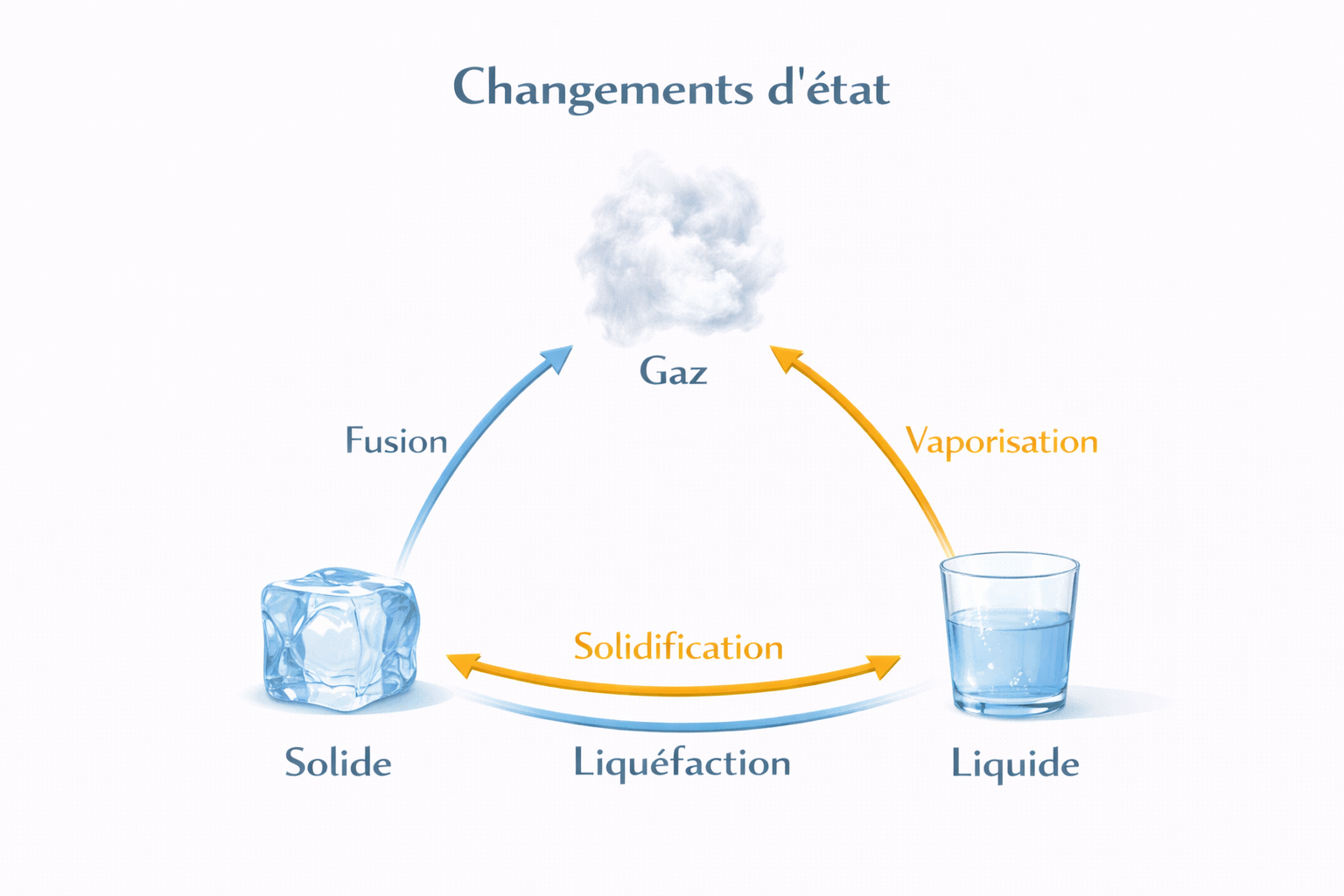
- Melting: solid → liquid (e.g., ice melting).
- Freezing: liquid → solid (e.g., water freezing).
- Vaporization: liquid → gas (e.g., water boiling or evaporating).
- Condensation: gas → liquid (e.g., fog forming on a cold window).
Evaporation is a slow form of vaporization that happens at the surface of a liquid without reaching boiling. For example, a puddle of water can slowly disappear.
| Change | From → To | Example |
|---|---|---|
| Melting | Solid → Liquid | Ice melting |
| Freezing | Liquid → Solid | Water freezing |
| Vaporization | Liquid → Gas | Water boiling / evaporation |
| Condensation | Gas → Liquid | Fog on a window |
There are other changes of state as well, such as sublimation (solid → gas) and deposition (gas → solid), also called solid condensation. For example, frost can form directly from water vapor in the air.
Matter can change its state without changing its nature. For example, water can be solid, liquid, or gas and still be water. Changes of state mainly depend on temperature, and sometimes also on other conditions like pressure. They are often reversible: ice can melt, and then the water can freeze again. Understanding these transformations helps explain many phenomena observed in nature and everyday life.
Matter mainly exists in three states: solid, liquid, and gas. Each state has particular characteristics of shape, volume, and particle arrangement. Matter can change from one state to another when heated or cooled: these are changes of state. These transformations explain many everyday phenomena, like ice melting, water evaporating, or fog appearing on a window. Understanding the states of matter is an important foundation for studying physical and chemical sciences in middle school.