Mixtures and Solutions
Problem — What is a mixture? How can we distinguish a mixture from a solution? How can the components of a mixture be separated?
- Understand what a mixture and a solution are.
- Identify different types of mixtures.
- Discover methods to separate the components of a mixture.
- Understand the importance of dissolution in forming a solution.
Part 1: What is a mixture?
A mixture is made up of several substances mixed together without a chemical reaction. Each substance retains its properties.
A mixture contains at least two different substances, visible or not, which can be separated by physical methods.
- Water + sand: a mixture where the components can be distinguished.
- Salt water: a mixture where salt is dissolved in water.
- A mixture contains several substances that coexist without chemically transforming.
Part 2: Homogeneous and Heterogeneous Mixtures
Homogeneous mixture
The substances are evenly distributed: the components cannot be distinguished with the naked eye. Examples: salt water, air.
Heterogeneous mixture
You can distinguish the different substances: several phases can be observed. Examples: water and sand, oil and water.
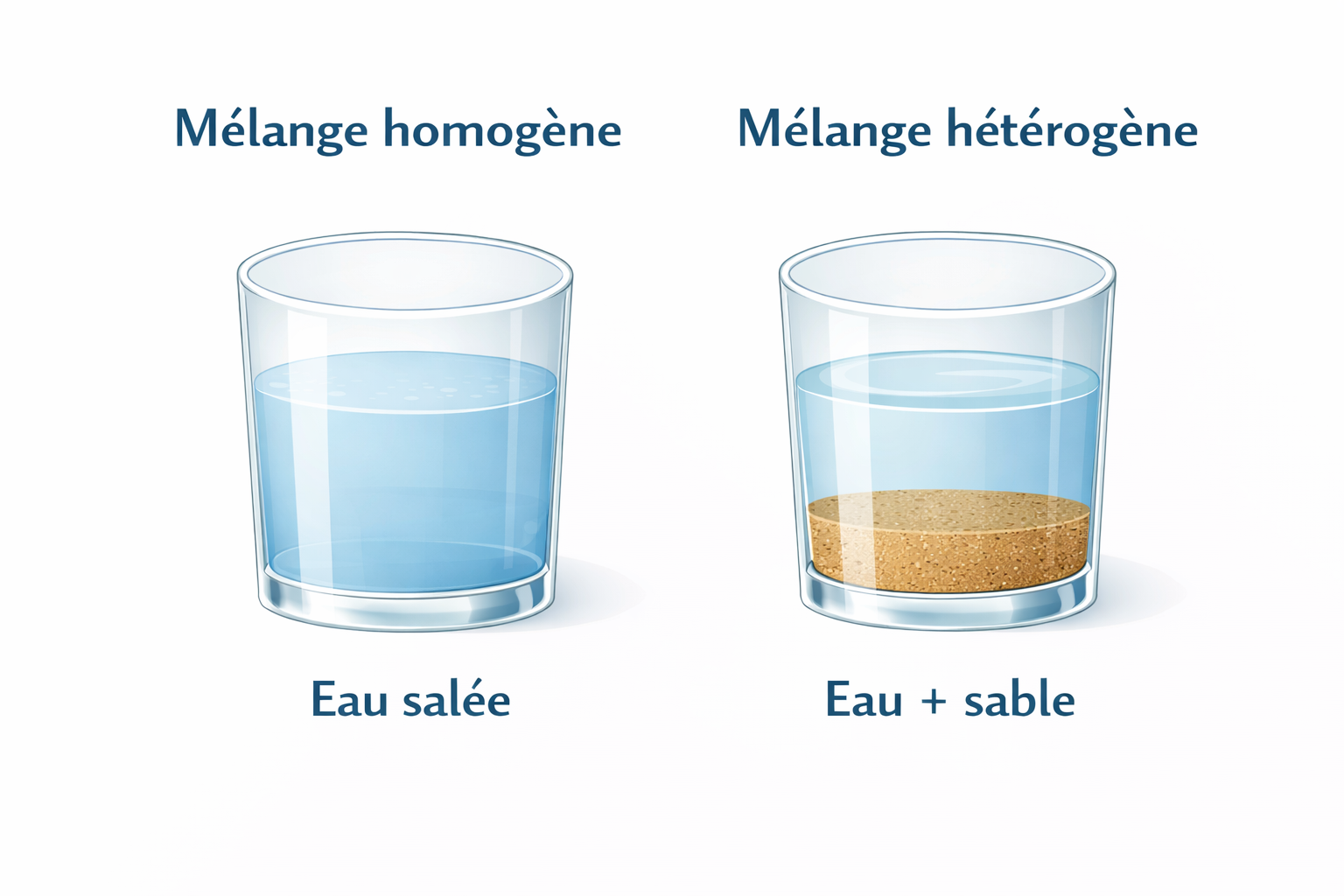
| Type of mixture | Description | Example |
|---|---|---|
| Homogeneous | Substances evenly distributed (one uniform appearance) | Salt water, air |
| Heterogeneous | Multiple visible phases | Water and sand, oil and water |
- Mixtures can be homogeneous or heterogeneous depending on the distribution of substances.
Part 3: Dissolution and Solution
Dissolution
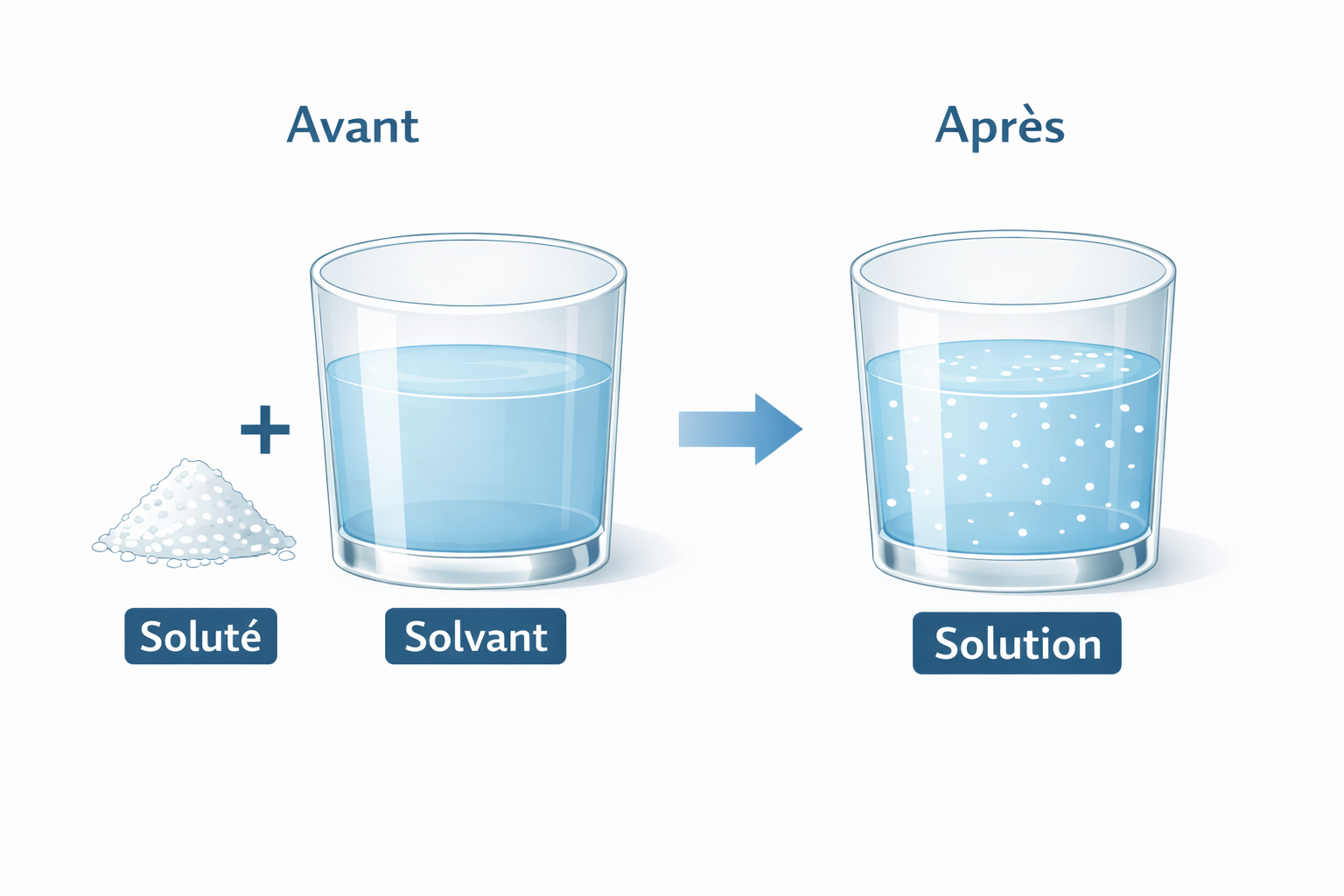
Dissolution is the process by which a substance (the solute) dissolves in a liquid (the solvent) to form a solution.
Solution
A solution is a homogeneous mixture where the solute is evenly spread throughout the solvent.
You cannot dissolve an infinite amount of solute: when the solvent can no longer dissolve more, you get a saturated solution (excess solute remains visible).
Salt dissolved in water forms a salt solution.
| Term | Role | Example |
|---|---|---|
| Solute | Dissolved substance | Salt (NaCl) |
| Solvent | Liquid that dissolves | Water |
| Solution | Homogeneous mixture obtained | Salt water |
- Dissolution allows formation of solutions, which are homogeneous mixtures.
- A solution can become saturated if too much solute is added.
Part 4: Separating the Components of a Mixture
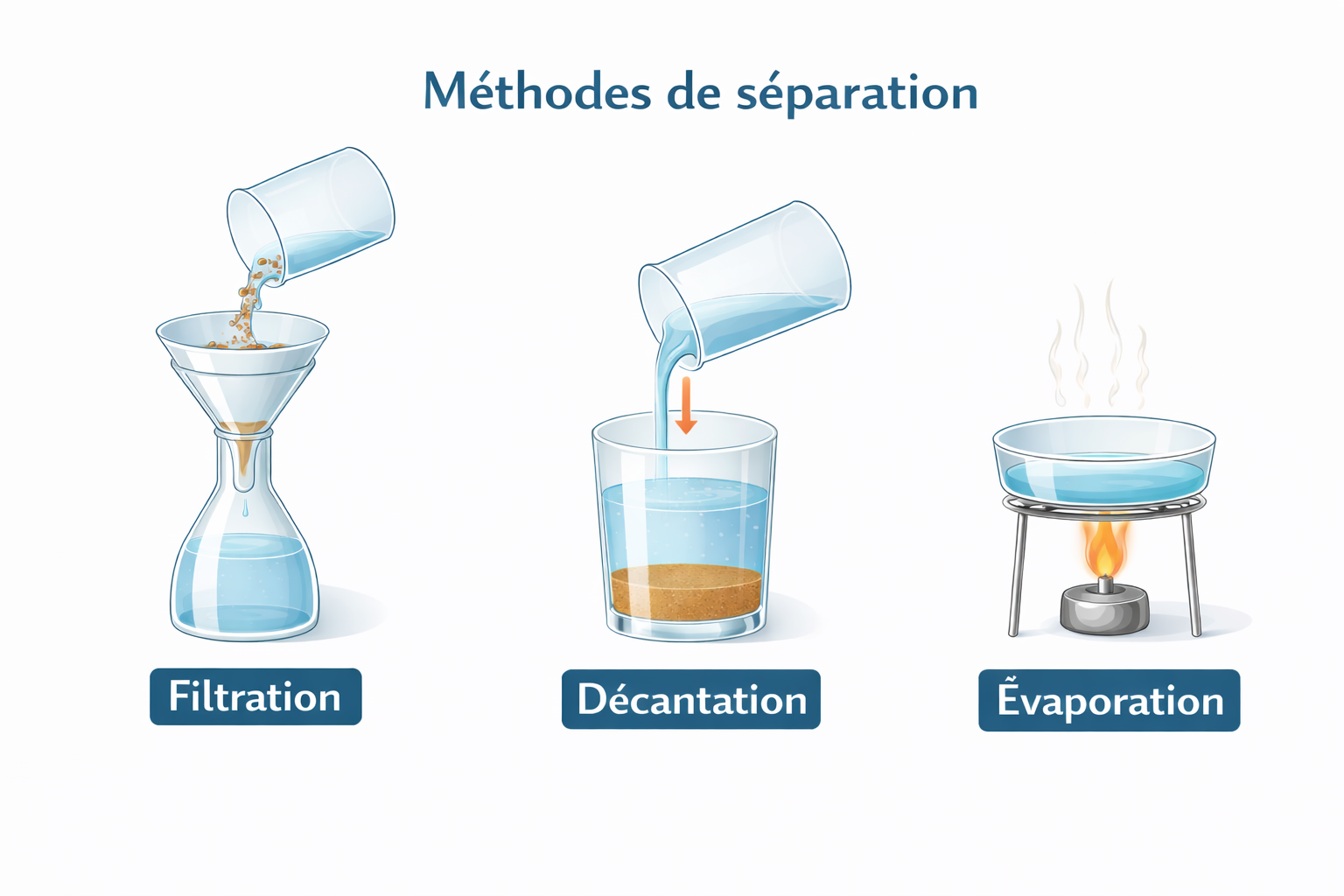
Depending on the nature of the substances, different methods can separate the components:
- Filtration: separate an undissolved solid from a liquid (e.g., sand and water).
- Sedimentation / decantation: let a denser solid settle, then pour off the clear liquid; or separate two immiscible liquids (e.g., water and oil).
- Evaporation: recover a dissolved solute by eliminating the solvent (e.g., salt crystals from salt water).
If we want to also recover the solvent (for example pure water), a different technique can be used: distillation (more advanced level).
| Method | Use | Example |
|---|---|---|
| Filtration | Separate undissolved solid / liquid | Sand and water |
| Sedimentation / decantation | Separate phases (settled solid or immiscible liquids) | Mud and water; water and oil |
| Evaporation | Separate dissolved solute and solvent (solute recovered) | Salt and salt water |
- Physical methods (filtration, decantation, evaporation) allow components to be separated according to their properties.
A mixture is made up of several substances which can be visible or not. Mixtures can be homogeneous (solutions) or heterogeneous (multiple phases). Dissolution creates solutions and can lead to a saturated solution if too much solute is added. To separate the components of a mixture, physical methods such as filtration, decantation, or evaporation are used.