Numbers and calculations
Problem — How to use numbers and operations to solve everyday problems in 6th grade?
- Identify the main types of numbers used in 6th grade: integers, decimals, simple fractions.
- Compare and order numbers (number line, notation).
- Perform correctly: addition, subtraction, multiplication, division.
- Apply the order of operations (parentheses → multiplication/division → addition/subtraction).
- Calculate with decimals (align decimal points; × and ÷ by 10, 100, 1000).
- Use mental calculation, written calculation, and calculator in a thoughtful way.
- Solve a problem by choosing the correct operations and writing an answer.
Part 1: Types of numbers
A number is used to count, measure, or compare quantities.
Integers
In 6th grade, we mainly use natural integers: 0, 1, 2, 3, …. They are used for counting. (Negative numbers will be studied later.)
Decimal numbers
A decimal number has an integer part and a decimal part separated by a comma: 3,14, 0,75, 12,5. They are often used for measurements (length, weight, price...).
Fractions
A fraction represents a part of a whole: 3/4 means "3 parts out of 4 equal parts".
A fraction can be:
- less than 1:
3/4 - equal to 1:
4/4 - greater than 1:
5/4(one and a quarter)
In 6th grade, we often work with simple fractions: 1/2, 3/4, 2/5, 7/10.
| Type | Description | Examples |
|---|---|---|
| Natural integer | For counting | 0 ; 5 ; 27 |
| Decimal | With a comma | 2.5 ; 0.75 ; 3.14 ; 12.0 |
| Simple fraction | Part of a whole (equal parts) | 1/2 ; 3/4 ; 7/10 |
Comparing and ordering numbers
To compare two numbers:
- First compare the integer part;
- If they are equal, compare the decimal part digit by digit;
- You can also place the numbers on a number line.
Examples:
4.2 = 4.20so4.20 < 4.35.3/4 = 0.75so0.75 < 0.8.
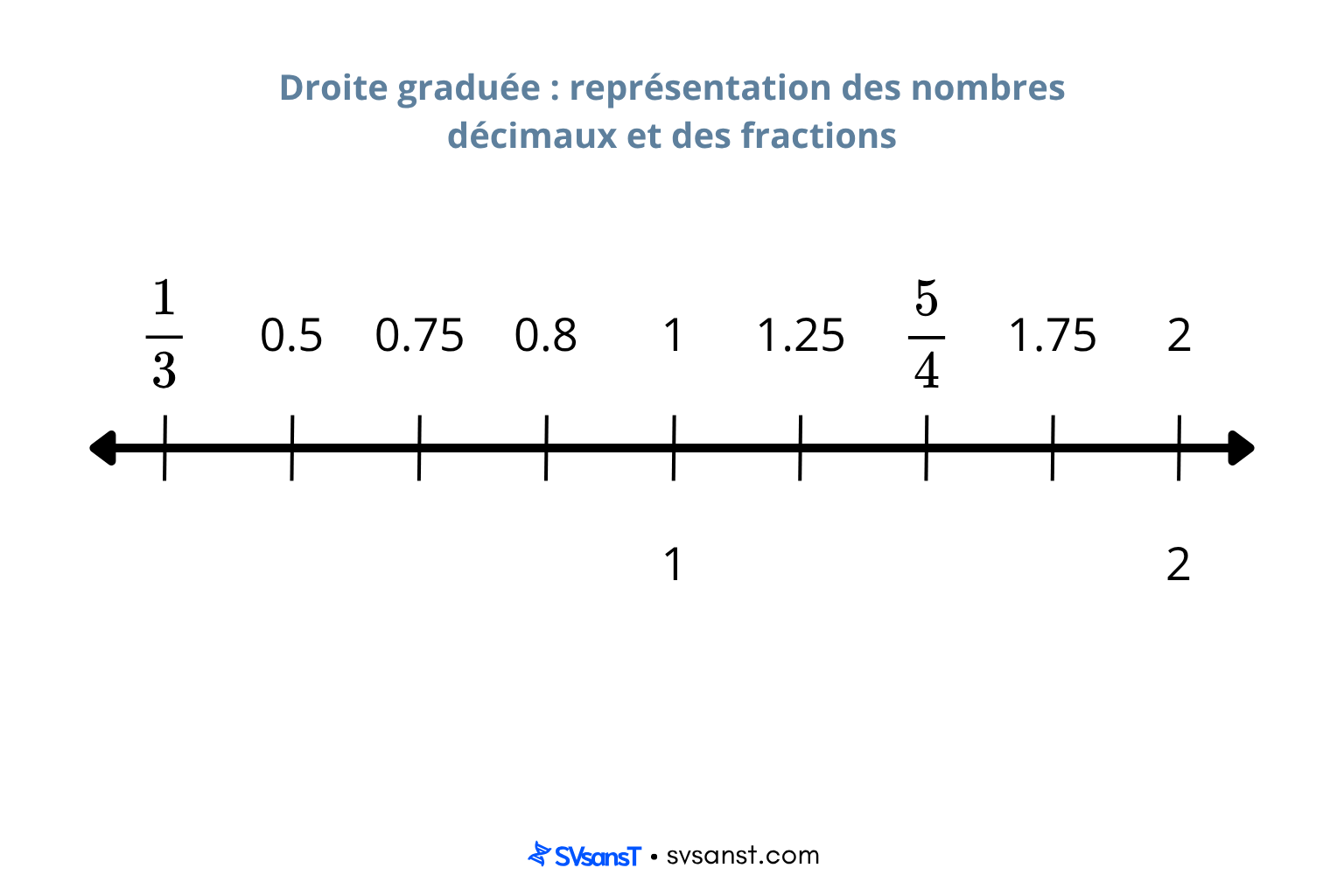
- In 6th grade, we mainly use: integers, decimals, and simple fractions.
- We need to be able to read, write, and compare them.
Part 2: Basic operations
Addition (+)
Allows you to combine quantities.
Subtraction (−)
Allows you to take away one quantity from another.
Multiplication (×)
Allows you to add the same quantity repeatedly.
Division (÷ or :)
Allows you to share a quantity into equal parts.
In 6th grade: we often use Euclidean division: 17 ÷ 5 = 3 with a remainder 2.
| Operation | Idea | Example |
|---|---|---|
| Addition | Combine | 5 + 3 = 8 |
| Subtraction | Take away | 10 − 4 = 6 |
| Multiplication | Equal groups | 4 × 3 = 12 |
| Division | Equal sharing | 12 ÷ 4 = 3 |
Calculating with decimals
Addition / subtraction: align the decimal points before setting up the calculation.
Multiply or divide by 10, 100, 1000
- Multiplying by 10, 100, 1000: the decimal point moves to the right.
- Dividing by 10, 100, 1000: the decimal point moves to the left.
3.7 × 10 = 37;3.7 × 100 = 37048 ÷ 10 = 4.8;48 ÷ 100 = 0.48
Order of operations
- Parentheses
- Multiplication and division (from left to right)
- Addition and subtraction (from left to right)
(12 + 8) × 3 = 60
12 + 8 × 3 = 36
Warning: 24 ÷ 3 × 2 is calculated left to right: 24 ÷ 3 = 8 then 8 × 2 = 16.
- The four operations allow solving calculations and problems.
- With decimals, we align the decimal points.
- We respect the order of operations.
Part 3: Mental calculation, written calculation, and calculator
Mental calculation
Calculate in your head using strategies.
25 × 4 = 100- Complete to 10 or 100:
38 + 2 = 40
Written calculation
Align the digits properly (and the decimal points if needed) to avoid mistakes.
Using the calculator
- Copy the calculation in the correct order and use parentheses.
- The calculator is used to check or for long calculations.
- Mental calculation → quick.
- Written calculation → reliable.
- Calculator → verification / long calculations.
Part 4: Problem solving
4-step method
- Understand: read, identify the data and the question.
- Choose: what operation fits the situation?
- Calculate: set up the calculation if needed.
- Answer: write a sentence (and the unit if there is one).
A store sells 3 packs of 4 pencils each.
Calculation: 3 × 4 = 12
Answer: "There are 12 pencils in total."
- Read → Choose → Calculate → Answer.
- Check that the answer is consistent.