Structure of the Atom
Problem — How is an atom, the smallest unit of a chemical element, made up?
How is an atom, the smallest unit of a chemical element, made up?
- Know the main parts of the atom: nucleus and electrons.
- Understand the composition of the nucleus: protons and neutrons.
- Know that electrons are found around the nucleus in electron shells.
- Link the number of protons to the identity of the chemical element.
Part 1: What is an atom?
An atom is the smallest part of a chemical element that retains its properties. It is extremely small and invisible to the naked eye.
The atom consists of a central nucleus and electrons that move around the nucleus in areas called electron shells.
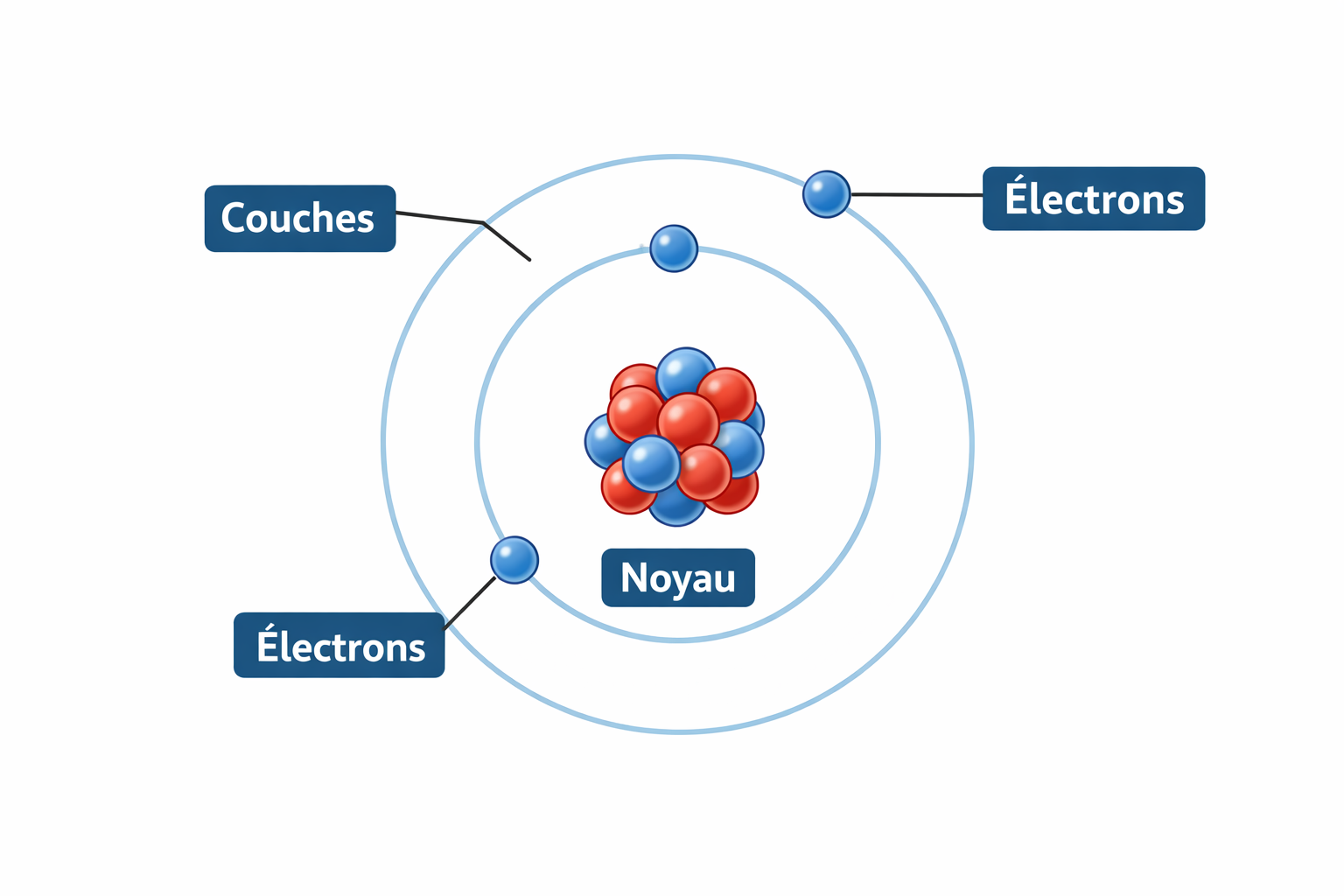
| Concept | Key idea |
|---|---|
| Atom | Smallest unit of a chemical element retaining its properties |
| General structure | Central nucleus + electrons around (electron shells) |
- The atom consists of a nucleus and electrons.
- An atom corresponds to a chemical element (e.g., carbon atom, oxygen atom...).
Part 2: The nucleus of the atom
The nucleus is the central part of the atom.
It contains particles called protons (positively charged) and neutrons (without charge).
The number of protons determines the chemical element: this is the atomic number, denoted Z.
- Z (atomic number) = number of protons.
- A (mass number) = number of protons + neutrons.
- Thus: number of neutrons = A − Z.
| Particle | Charge | Role / Remark |
|---|---|---|
| Proton | Positive | Its number (Z) determines the chemical element |
| Neutron | None (no charge) | With protons, it forms the nucleus |
- The nucleus contains protons (+) and neutrons (0).
- The number of protons (Z) defines the identity of the atom.
Part 3: Electrons around the nucleus
Electrons are negatively charged particles.
They move around the nucleus and are distributed in areas called electron shells.
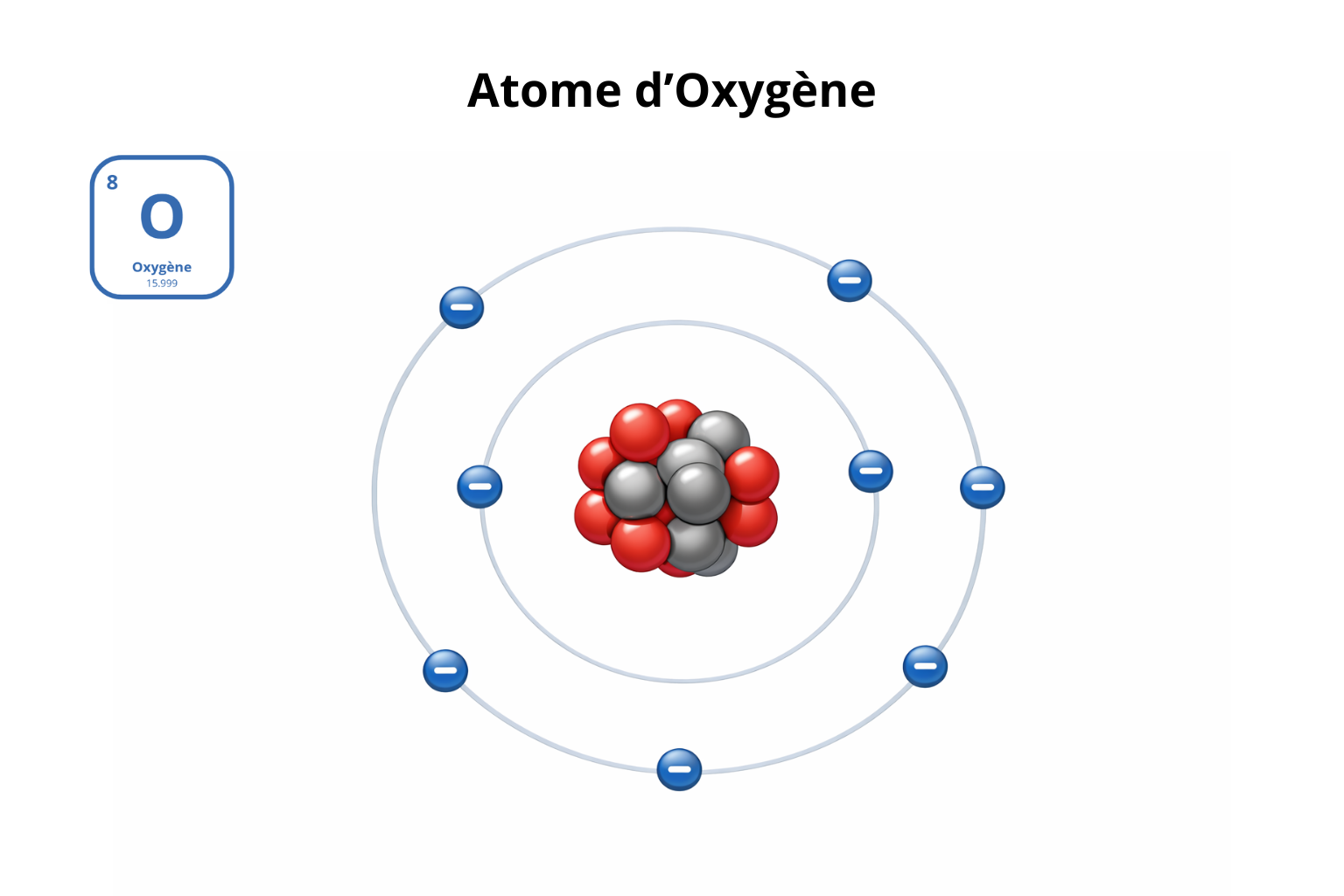
In a neutral atom, the number of electrons equals the number of protons.
If an atom gains or loses electrons, it becomes an ion: it can be positively charged (loss of electrons) or negatively charged (gain of electrons).
| Concept | Key idea |
|---|---|
| Electron | Negatively charged particle |
| Electron shells | Areas where electrons are distributed around the nucleus |
| Neutral atom | Number of electrons = number of protons |
- Electrons (–) are distributed around the nucleus in electron shells.
- An atom is neutral if the number of electrons equals the number of protons.
The atom consists of a nucleus made of protons (+) and neutrons (0), surrounded by electrons (–) distributed in electron shells. The number of protons (Z) defines the chemical element. A neutral atom has as many electrons as protons; if it gains or loses electrons, it becomes an ion.