Classification of Living Things
Problem — How to organize and classify the great diversity of living things on Earth?
How to organize and classify the great diversity of living things on Earth?
- Understand why it is important to classify living things.
- Discover how attributes are used to form nested groups.
- Recognize major types of living organisms (animals, plants, fungi, bacteria).
- Understand the concept of species.
Part 1: Why classify living things?
The diversity of life
Earth is home to an immense variety of living things: animals, plants, fungi, bacteria, and many microscopic organisms. This diversity is so vast that it is difficult to make sense of it without an organization system.
Classification is a method that groups living things according to shared characteristics, called attributes.
Why classify?
- To facilitate the identification and study of living things.
- To compare living things through common characteristics.
- To highlight relationships: living things that share many attributes are often more closely related.
Animals that have a backbone are grouped as vertebrates because they share this attribute.
Classifying living things is essential to better understand the diversity of life. Classification is not just about placing species into categories: it also allows comparison of organisms based on shared traits. In 6th grade, it is important to remember that living things are not classified “at random” but by observing precise attributes. This method helps scientists study living things better and understand their similarities.
Part 2: Classification criteria
What is the basis?
To classify living things, we observe attributes, which are characteristics that some have and others do not.
- Presence of a backbone, limbs, wings…
- Presence of hair, feathers, a shell…
- In plants: presence of leaves, flowers, seeds…
- At the cellular level: presence or absence of a nucleus, useful for distinguishing bacteria from other cellular living things.
An attribute is a characteristic shared by some living things, for example hair, a backbone, or flowers.
Major types of living things
Several major groups can be distinguished, without yet going into all scientific classification details:
| Major group | Simple characteristics | Examples |
|---|---|---|
| Bacteria | Unicellular, cells without a nucleus | Lactic acid bacteria in yogurt |
| Fungi | Feed by absorption, often multicellular | Yeast, mold, common mushroom |
| Plants | Often multicellular, perform photosynthesis | Oak tree, grass, fern |
| Animals | Multicellular, feed by ingestion | Cat, insect, fish |
| Other microscopic eukaryotes | Unicellular with a nucleus | Amoeba, paramecium |
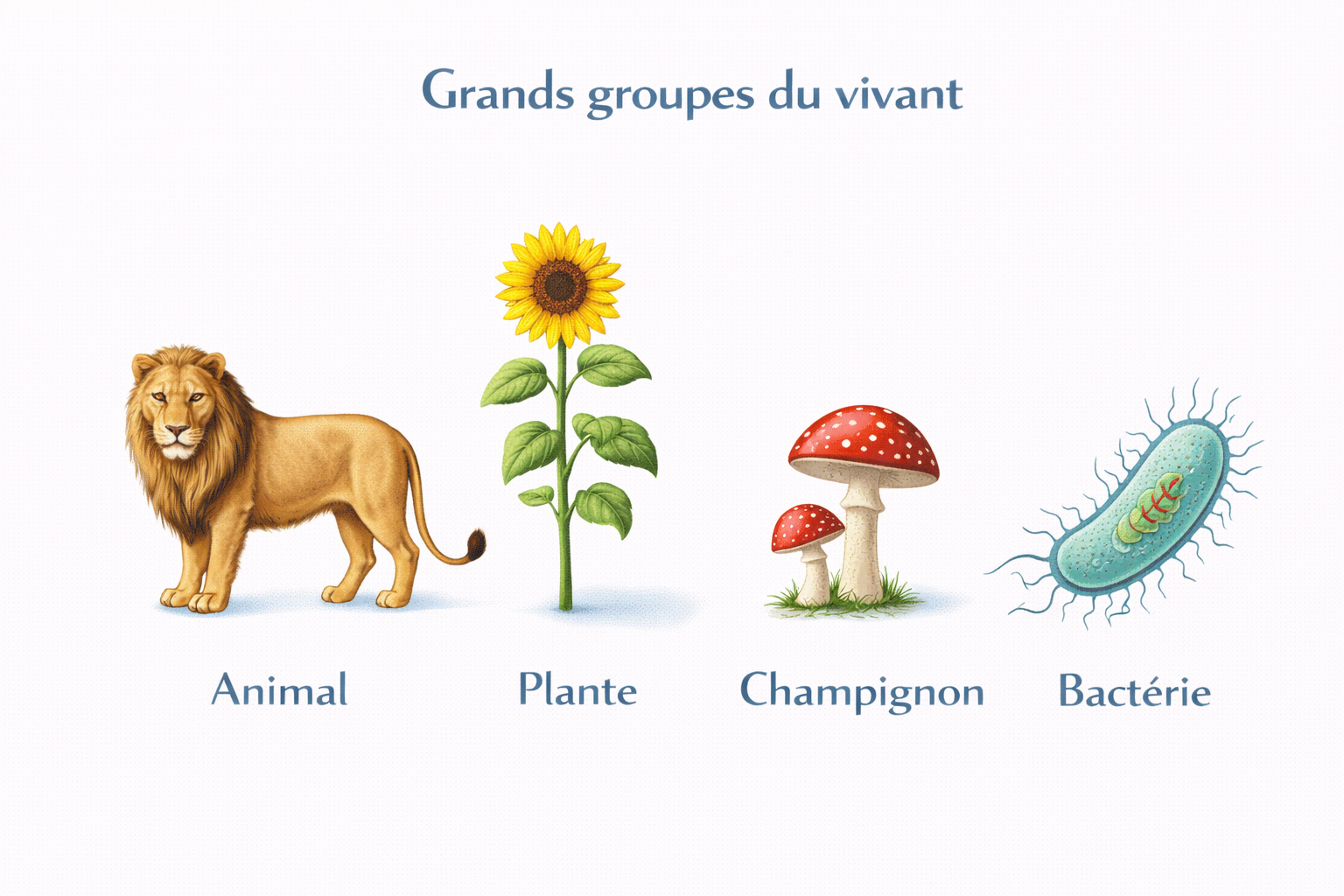
- Unicellular: a living being made up of a single cell.
- Multicellular: a living being made up of multiple cells.
- Photosynthesis: production of matter by certain cells using light, especially using water and carbon dioxide.
Living things are classified based on observable attributes. These attributes allow the formation of groups of living things that share common characteristics. The more precisely organisms are observed, the more rigorous the classification can be. In 6th grade, it is important to understand that the criteria used must be precise and comparable from one living thing to another. This is how large groups like animals, plants, fungi, and bacteria can be distinguished.
Part 3: Nested groups, from broad to specific
Nested groups
In classification, one group can be included within another. The more attributes added, the more specific the group becomes:
- Animals: a very broad group.
- ⟶ Vertebrates: animals with a backbone.
- ⟶ Mammals: vertebrates having hair and mammary glands.
- ⟶ Felines: mammals sharing characteristics unique to this group.
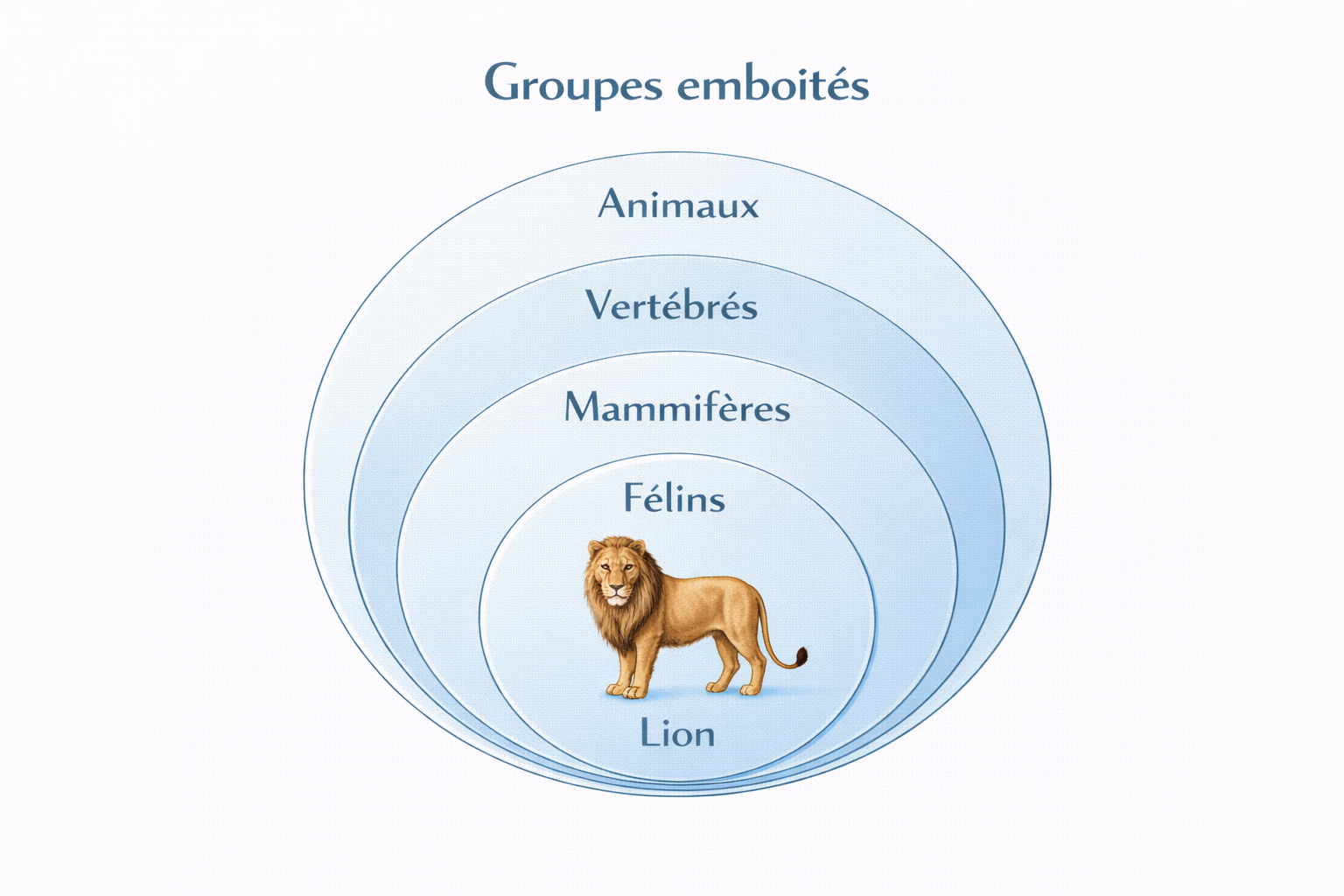
A species is a group of living things that look very similar and can, most often, reproduce with each other and have fertile offspring.
The lion is an animal, a vertebrate, a mammal, and a feline. Its species is Panthera leo.
Scientists also use other classification levels, such as genus, family, or species. In 6th grade, the most important is to understand attributes and nested groups.
Classification is organized by nested groups: a broad group can contain increasingly specific groups. This organization helps better understand the similarities among living things and progressively distinguish groups down to the species. It must be remembered that a living thing can belong to multiple groups at once. This idea is essential to understand the logic of modern scientific classification.
The classification of living things organizes the immense diversity of life based on common attributes. By observing precise characteristics, organisms are grouped into nested groups from broad to specific, down to the species. This method facilitates the study of life, helps recognize major groups of living things, and better understand their similarities. Classifying living things means learning to observe, compare, and organize the diversity of the living world more effectively.