The Basics of Life
Essential question — What characterizes a living thing and how can we understand the diversity of life?
- Discover what a living thing is.
- Understand the common characteristics shared by all living things.
- Gain an overview of cells, vital functions, reproduction, and the diversity of life.
- Introduce the importance of tools like the microscope for studying living things.
Part 1: What is a Living Thing?
A living thing is an organism that performs activities essential to life. These activities are called vital functions.
Most living things feed, exchange with their environment (gases, water…), grow, and react to their surroundings. Reproduction allows the species to continue across generations.
- A tree produces part of its matter through photosynthesis.
- A cat performs gas exchange to obtain oxygen.
- A bacterium reproduces rapidly by dividing.
- An alga lives in water and reacts to changes in light.
Note — Even though these living things are very different, they share characteristics that distinguish them from non-living objects like a stone or a car.
- Living things perform vital functions.
- These functions distinguish them from non-living objects.
Part 2: The Cell, the Unit of Life
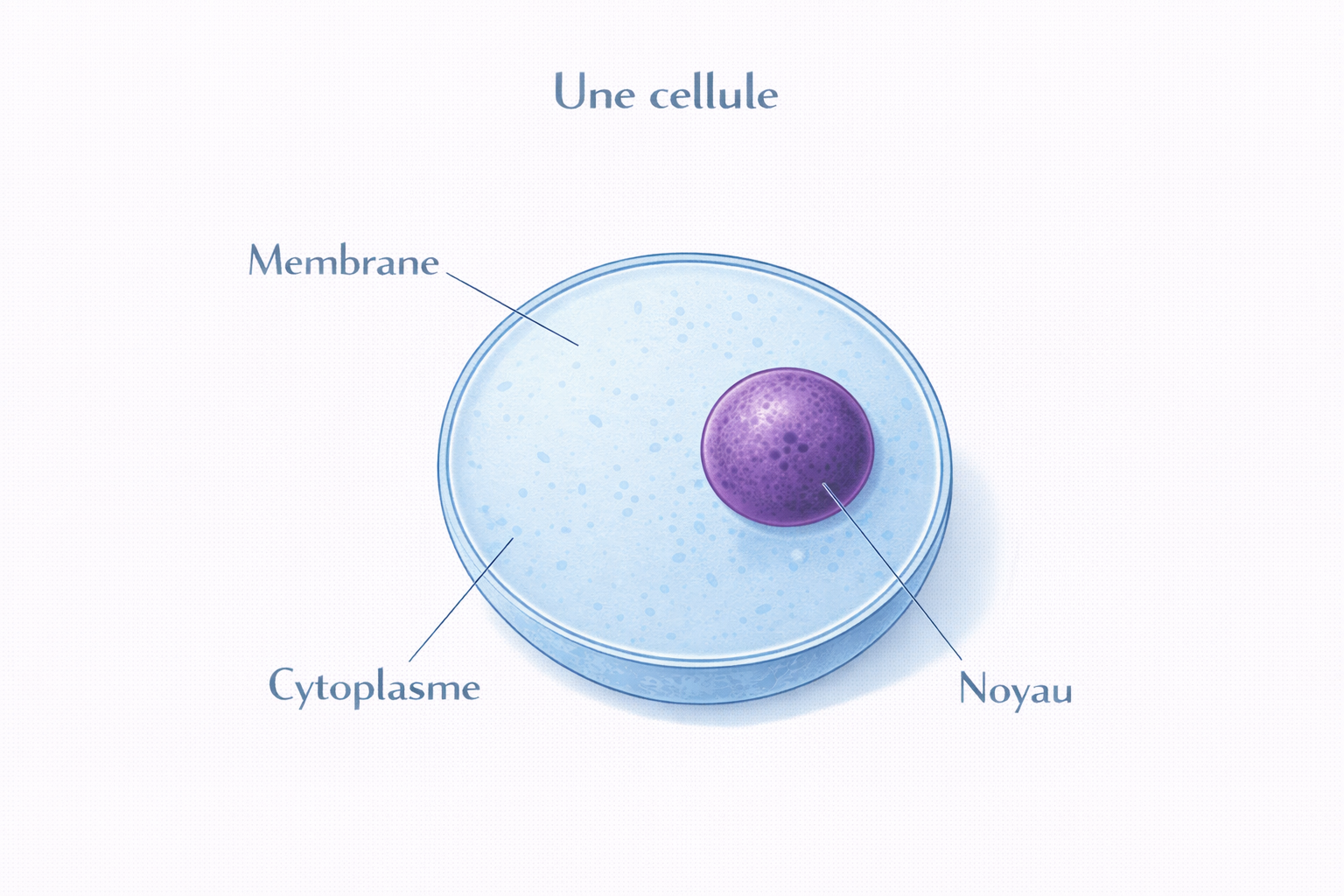
All living things are made up of cells, the basic units of life.
Note: Viruses are not cells.
Types of organisms based on the number of cells
- Unicellular: made of a single cell. Examples: bacteria (without a nucleus), amoebas or paramecia (with a nucleus).
- Multicellular: made of multiple cells. Examples: plants, animals, fungi.
The Microscope
The microscope is an essential tool that allows us to see cells, which are invisible to the naked eye. Thanks to it, scientists understood that all living things are made of cells.
Example of Observation
Under the microscope, we can see that plant cells have a rigid cell wall and chloroplasts, while animal cells lack a rigid wall and have a more variable shape.
- The cell is the basic unit of life.
- Both unicellular and multicellular organisms share cellular organization.
- The microscope is essential for observing cell structure.
Part 3: Vital Functions
All living things carry out functions essential for their survival.
Nutrition
This is the way a living thing obtains matter and energy needed for growth. For example, plants produce part of their matter through photosynthesis, while animals feed on other living things.
Respiration (exchange and energy production)
Many living things use oxygen to release energy from nutrients. In humans, respiration allows oxygen to enter the lungs.
Reproduction
This is the ability to produce new individuals, ensuring the continuity of the species. Some living things reproduce sexually (animals, flowering plants), others asexually (certain bacteria, yeasts).
Responding to the Environment
Living things can move (like animals) or react to changes around them (like plants orienting towards light).
| Function | Role | Examples |
|---|---|---|
| Nutrition | Obtain matter and energy | Photosynthesis in plants; feeding in animals |
| Respiration | Release energy (often with oxygen) | Gas exchange in humans, cellular respiration |
| Reproduction | Produce new individuals | Sexual (animals); asexual (bacteria) |
| Environmental Response | Adapt to environmental changes | Phototropism in plants; fleeing in animals |
- Vital functions ensure survival and species continuity.
- They exist in all living things despite the diversity of life forms.
Part 4: The Diversity of Living Things
Earth hosts an immense variety of living things, which can be grouped into major categories based on their characteristics.
| Group | Description | Examples |
|---|---|---|
| Bacteria | Unicellular without nucleus | Soil bacteria |
| Other microscopic eukaryotes | Unicellular with nucleus | Paramecia, amoebas |
| Fungi | Often multicellular, sometimes unicellular | Mushrooms, yeasts |
| Plants | Multicellular, produce part of their matter (photosynthesis) | Trees, flowers |
| Animals | Multicellular, feed on other living things | Mammals, insects |
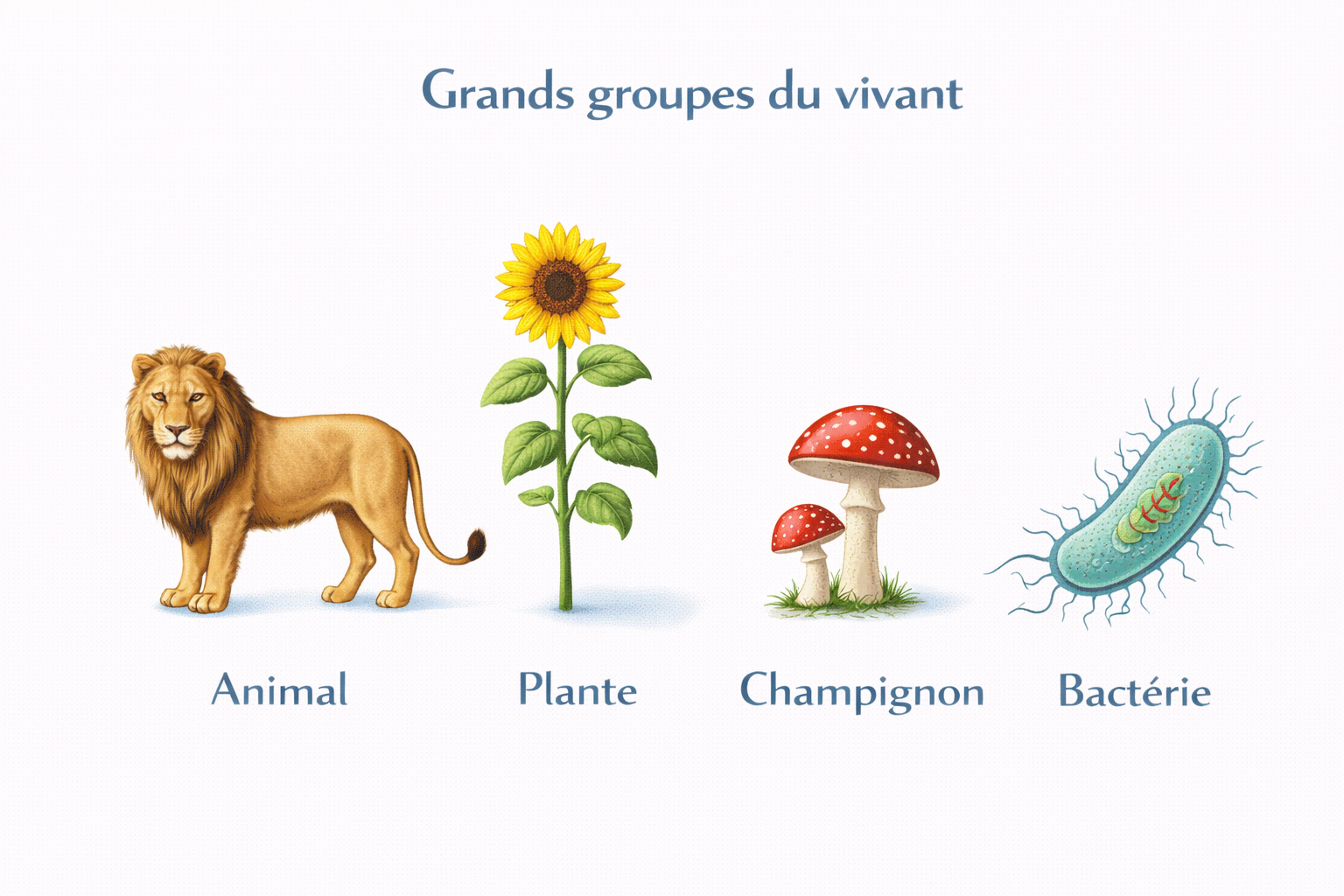
The Importance of Classification
This organization helps us better understand the similarities and differences among living things, and to study their evolution.
- The diversity of life is immense and structured by shared criteria.
- Classification helps organize and understand this diversity.
Living things share common characteristics: they are made of cells, perform vital functions (nutrition, exchange with the environment, reproduction, response to surroundings), and live in varied habitats. The diversity of life is immense and organized through classification. The microscope is a key tool that led to the discovery of the cell and deepened our understanding of the living world. This course lays the foundations to better understand life in all its forms.